How Much Data Does Streaming Use? Netflix, YouTube, Live Sport and Music (2026)

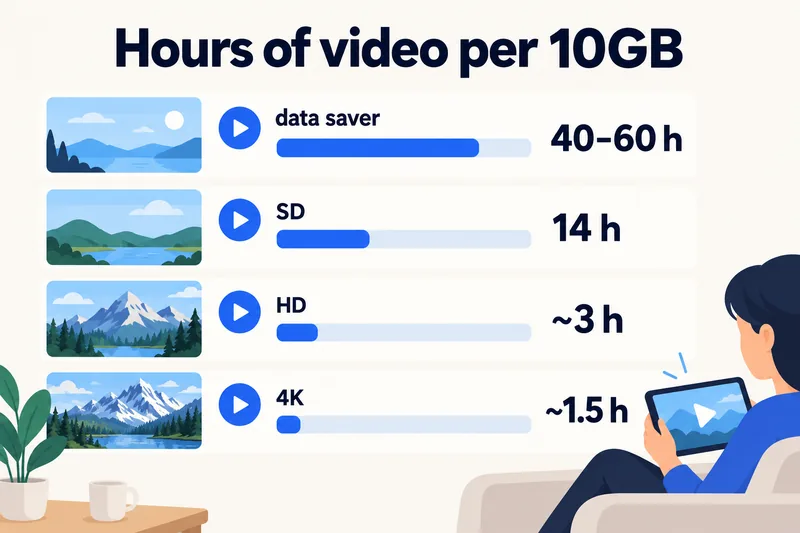
Video streaming uses about 0.3 GB an hour at low quality, 0.7–1 GB in SD, around 3 GB in HD and 7 GB in 4K. A phone data saver can cut that to 170–250 MB an hour. Music needs 40–150 MB an hour. 10GB is about 14 hours of SD, or 3 in HD.

The hotel Wi-Fi gives up just as the evening's film starts, and the only fallback is the travel eSIM on your phone. How far that gets you depends on the quality setting far more than on which service you open. Below: figures per quality, what Netflix, Disney+, YouTube, HBO Max and Apple TV actually let you set, live sport, music, how many hours a given plan gives you, and how to stream on a trip without running out.
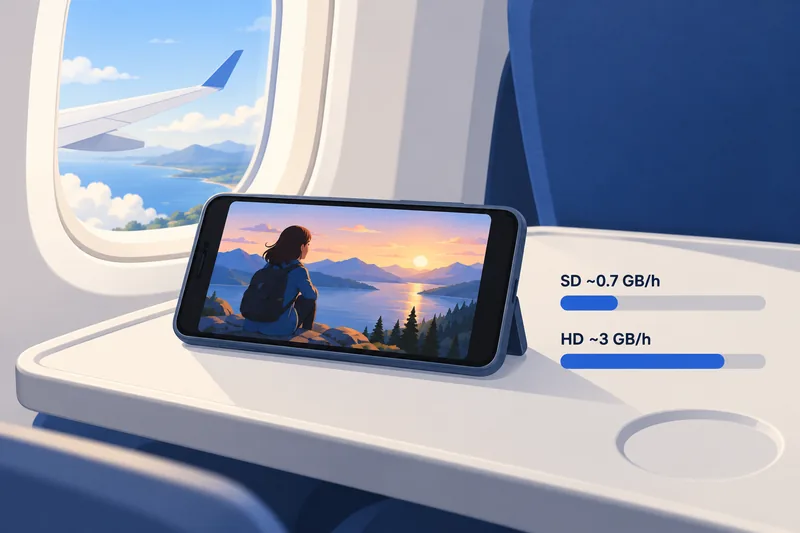
Streaming data usage by quality
Netflix is the only major service whose per-hour figures we could verify on its own help page, and Australian carrier Telstra uses the same numbers. They are the rates our travel data calculator uses for video.
| Quality | Data per hour | 2-hour movie | 1GB lasts about |
|---|---|---|---|
| Phone app, data saver (Netflix Save Data) | ~170 MB | ~0.35 GB | 6 hours |
| Phone app, automatic (Netflix) | ~250 MB | ~0.5 GB | 4 hours |
| Low (basic quality) | up to 0.3 GB | ~0.6 GB | 3 h 20 min |
| Standard definition (SD) | 0.7–1 GB | 1.4–2 GB | 1–1.5 hours |
| HD (720p–1080p) | 1.5–3 GB | 3–6 GB | 20–40 minutes |
| 4K / Ultra HD | ~7 GB (YouTube 4K up to ~15 GB) | ~14 GB | under 10 minutes |
Figures are from Netflix's help page (checked 1 October 2026), Telstra, and carrier StarHub for YouTube 720p (about 1.8 GB an hour) and 4K (about 15 GB). Our calculator counts "low" as 300 MB an hour, which is Netflix's web setting; phone apps with a data saver use less, so it errs on the safe side.
Service by service: what you can set
| Service | Settings for mobile data | Published figures | Offline downloads |
|---|---|---|---|
| Netflix | App: Automatic, Wi-Fi Only, Save Data, Maximum Data | Save Data ~6 h per GB; Automatic ~4 h per GB; Maximum "1 GB per 20 minutes or more" | Yes, up to 100 per device; some titles expire |
| Disney+ | A data usage setting with a Save Data option | Firsty (June 2026), citing Disney+'s help page, lists ~0.6 GB/h (Save Data) and ~2 GB/h (Automatic) on mobile | Yes |
| YouTube | Video quality preferences: Auto, Higher picture quality, Data saver, Advanced | None published | YouTube Premium |
| HBO Max | Auto quality; Stream over Cellular can be turned off | None published | Yes, download quality Good / Better / Best |
| Apple TV app | High Quality or Data Saver; Use Cellular Data on or off | None published | Yes, High Quality or Fast Downloads |
| Prime Video | Streaming quality chosen in the app | Not checked; third-party figures disagree | Yes |
Disney+'s figures come from a third-party summary and Prime Video publishes none, so treat those rows as indicative. For individual guides, see YouTube data use by quality and Viki data use per episode.
Phone or TV makes a difference
Why does the same film use less on a phone than on a TV? Many services cap phone streams below what a TV gets. Netflix's phone settings top out around 3 GB an hour on Maximum Data, and a third-party summary of Disney+'s help page puts its phone ceiling around 2 GB an hour, while a 4K TV can use 7 GB or more. If you cast to a hotel TV over your phone's hotspot, plan with the TV figures.
Need data for your trip? Compare eSIM plans by validity and data volume.
View eSIM plansLive sport and live streams
Does live sport cost more than a film? Per hour, no: live events stream at the same rates as other video at the same quality. UK broadband provider Virgin Media puts an HD football match at around 3 GB an hour and 4K live sport at 7–10 GB an hour.
A 90-minute match with build-up and half-time therefore uses roughly 4.5–6 GB in HD, or about 1–1.5 GB in SD. Live streams cannot be downloaded in advance, so on mobile data the quality setting is your only lever.
Music and podcasts
Audio is in another league. From the bitrates Spotify publishes: about 11 MB an hour on Low, 43 MB on Normal, 72 MB on High and 144 MB on Very high. Lossless is much heavier and Spotify gives no exact figure. Our Spotify data guide has the full table, including video podcasts. Short-video apps sit between music and films; see TikTok's data use.
How many hours does your plan give you?
| Plan size | Phone data saver (~170–250 MB/h) | SD (~0.7 GB/h) | HD (~3 GB/h) | Music on High (~72 MB/h) |
|---|---|---|---|---|
| 5GB | 20–30 hours | 7 hours | under 2 hours | 70 hours |
| 10GB | 40–60 hours | 14 hours | about 3 hours | 140 hours |
| 20GB | 80–120 hours | 29 hours | about 7 hours | 280 hours |
| 50GB | 200+ hours | 70 hours | about 17 hours | 700 hours |
These hours assume the whole plan goes on streaming; on a trip, maps, messaging and social media take their share first.
How to stream on a trip without running out
Download on Wi-Fi
Download episodes and films at the hotel. Downloading uses roughly the same data as streaming once, but on Wi-Fi it costs nothing from your plan, and offline playback uses no mobile data.
Set each app's mobile quality
Netflix: Save Data in the app's cellular settings. YouTube: Data saver under Video quality preferences, On mobile networks. Apple TV: Data Saver. HBO Max: turn off Stream over Cellular if you only want to watch on Wi-Fi.
Turn on the phone's own saver
Low Data Mode on iPhone (per line, under Cellular Data Options) or Data Saver on Android cuts background use and nudges apps to lower quality.
Watch your first day's usage
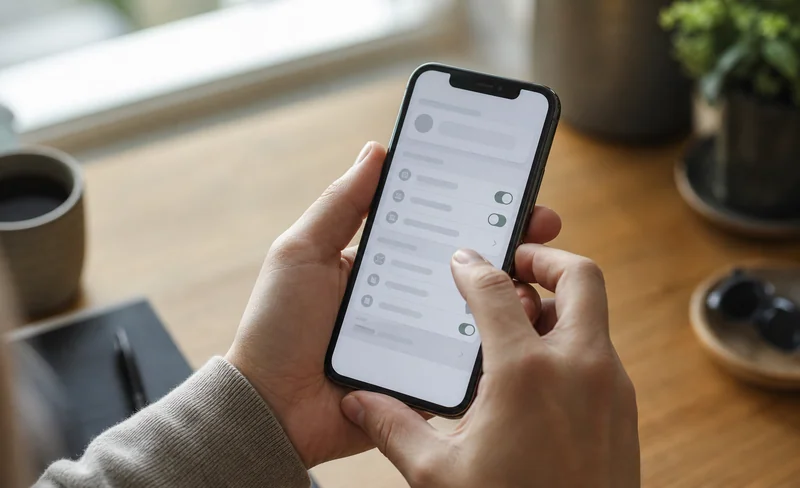
After the first night of streaming, open Settings, Cellular (iPhone) or Data usage (Android), note what Netflix or Disney+ used and multiply by the nights left. Where those apps appear on the iPhone screen is shown step by step in how to check and manage data usage on iPhone.
How much data to buy if you stream while travelling
Our calculator's "moderate" traveller uses about 1.3 GB a day before any streaming (20% buffer included). Add an hour of SD video a day and that becomes about 2.1 GB, or 15 GB a week; an hour in HD pushes it to about 4.9 GB a day, roughly 34 GB a week. Priced out for a week in Thailand, using the Zyesims price list of 1 October 2026:
| How you stream | Data for 7 days | Plan that fits | Price |
|---|---|---|---|
| Downloads on Wi-Fi, music on mobile data | ~3–4 GB | Thailand 5GB, 30 days | ₩13,200 |
| An hour of SD video a day | ~15 GB | Thailand 20GB, 30 days | ₩27,000 |
| An hour of HD video or live sport a day | ~34 GB | Thailand 50GB, 10 days | ₩26,300 |
For a trip of up to 10 days, compare the 50GB plan (₩26,300) with 20GB for 30 days (₩27,000): per GB that is ₩530 against ₩1,350, so heavy streamers on a short trip get more data for the money. To model your own mix, open the calculator with Thailand and 7 days and set the "movies and YouTube" hours, or browse all Thailand eSIM plans and our unlimited eSIM range.
Why Zyesims for streaming abroad
Every plan shows its data and validity before you pay, and for video the plan type matters: Unlimited Standard (1GB a day) and Plus (3GB a day) slow down after the daily cap, and the provider gives no figure for that slower speed, so once you pass it expect messages and maps to load but not a film. A fixed plan sized from the table above keeps HD at full speed until the data runs out.
Frequently Asked Questions
How much data does 1 hour of streaming use?
For video, about 0.3 GB at low quality, 0.7–1 GB in standard definition, around 3 GB in HD and about 7 GB in 4K, based on Netflix's published figures. On a phone app with a data saver on it can be as little as 170–250 MB. Music streaming uses far less, roughly 40–150 MB an hour.
How much data does a 2-hour movie use?
Roughly 0.35–0.5 GB in a phone app on Save Data or Automatic, 1.4–2 GB in standard definition, about 6 GB in HD and around 14 GB in 4K. Downloading the film on Wi-Fi before you leave avoids using any mobile data for it.
How much data does watching live sport use?
About the same per hour as other video at the same quality: around 3 GB an hour in HD and 7–10 GB in 4K. A 90-minute football match in HD with some build-up is roughly 4.5–6 GB, or about 1–1.5 GB in standard definition.
Is 10GB enough for streaming on a trip?
For light streaming, yes: 10GB covers about 14 hours of standard-definition video, or around 40–60 hours with a phone data saver. In HD it is only about 3 hours. If you watch daily in HD, choose a much larger plan or download on Wi-Fi.
Does downloading use less data than streaming?
A download at the same quality is roughly the same size as streaming it once. The difference is when and where you use the data: download on hotel or home Wi-Fi and you can watch offline later with no mobile data at all.
Keep reading
- Fair Usage Policy on Unlimited eSIMs: Daily Caps & Throttling
- What Do Internet Speeds Really Mean? Mbps, 4G & 5G for Travelers
- Can You Hotspot with an eSIM? Limits, Data Use and Fixes for Travelers
- What Is Data Roaming? 2026 Costs and Cheaper Alternatives
- How to Buy an eSIM Online: A Simple Guide for Travelers

A travel and tech enthusiast who loves to wander and discover new places. Mihi writes Zyesims' guides to eSIMs and mobile data abroad, built from carriers' and app makers' own documentation, published plan terms and Zyesims' current plan data, with sources named in each article. Mihi also writes about travel at MihiTravel and Notemeeting.
Ready for your next trip?
Choose the right eSIM, get your QR code by email, and connect when you land: coverage in 200+ countries.