Best eSIM for Japan in 2026: Plans, Networks and Real Prices Compared

For most trips to Japan, the best eSIM is a 20GB, 30-day plan on a multi-network eSIM. At Zyesims that costs $13.99, or $0.70 per GB, and connects to Docomo, au, SoftBank and Rakuten. Heavy users can pick an unlimited plan with no daily speed cap ($15.49 for 7 days), and anyone heading deep into the countryside should make sure Docomo is on the list.
That covers most trips. The rest of this guide is for travelers who need a Japanese IP address, a Japanese phone number, one eSIM for Japan and Korea, or who simply want to see how the big brands compare on price. Prices below were checked in late September 2026; the few taken from independent comparisons are marked under the price table.

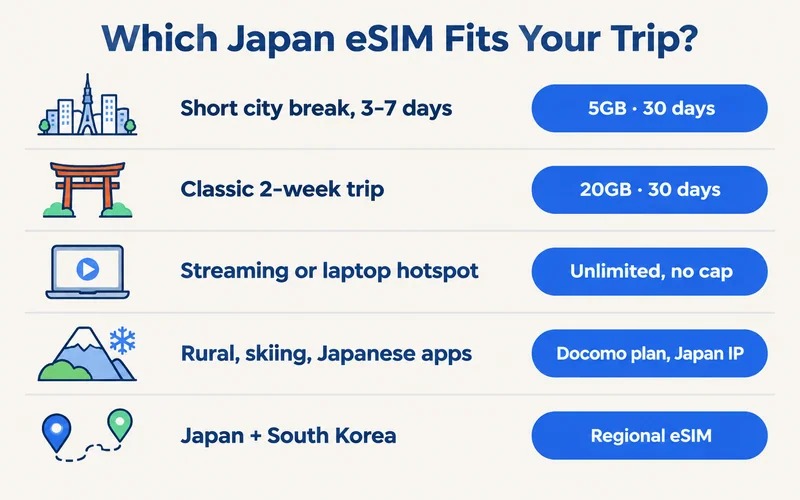
The best Japan eSIM for each kind of trip
There is no single winner for every traveler. A weekend in Tokyo and a month on a rail pass need very different plans. Start from the way you travel, then pick the plan size.
| Your trip | What to buy | Zyesims price | Why it fits |
|---|---|---|---|
| Short city break, 3–7 days, light use | 5GB, 30 days | $5.49 | Maps, LINE, translation and some Instagram, with days to spare |
| Classic 2-week trip (Tokyo, Kyoto, Osaka) | 20GB, 30 days | $13.99 | About 1.4GB a day, enough for social media and video calls home |
| Streaming, hotspot for a laptop, content creation | Unlimited Premium, no daily speed cap | $15.49 / 7 days, $28.99 / 15 days | No daily speed cap (carriers' fair-use terms still apply), hotspot allowed |
| Budget unlimited for everyday use | Unlimited Plus, 3GB a day at full speed | $12.99 / 7 days, $24.49 / 15 days | 3GB a day is more than most people use, then it slows down instead of stopping (the provider doesn't publish the reduced speed) |
| Rural routes, skiing, Japanese sites and apps | 20GB, 30 days (IIJ, Docomo) | $13.99 | Docomo coverage plus a Japanese IP address |
| Long stay or several trips | 50GB, 180 days | $42.49 | Six months to use the data |
| Japan and South Korea on one trip | Japan & South Korea 5GB, 30 days | $11.49 | One eSIM, no switching at the border |
If you are between two sizes, buy the bigger one. The gap between 10GB ($8.99) and 20GB ($13.99) is five dollars, and running out in the middle of a Shinkansen transfer costs more in stress than that. Every plan is listed on the Japan eSIM page, sorted by data and by days.
Japan eSIM prices compared: Zyesims, Airalo, Holafly, Saily, Ubigi
Most comparison articles rank brands. Your wallet cares about two numbers instead: what 20GB costs, and what a week of unlimited data costs. Here are both, side by side, including us.
| Provider | 20GB, 30 days | Unlimited, 7 days | Unlimited, 30 days | Japanese networks | Daily limit on unlimited |
|---|---|---|---|---|---|
| Zyesims | $13.99 | $15.49 (Premium) | $52.99 (Premium) | Docomo, au, SoftBank, Rakuten (Hong Kong IP; IIJ plan: Japanese IP, Docomo) | Premium: no daily cap, fair use applies. Standard 1GB and Plus 3GB a day, then a reduced speed the provider doesn't publish |
| Airalo | about $25 | $26.50 | $69.00 | SoftBank, au (KDDI) | 3GB a day at full speed, then 1 Mbps |
| Holafly | No fixed plans | $27.50 | $73.90 | KDDI, SoftBank | Fair use; hotspot capped at 1GB a day |
| Saily | $24.99 | $26.99 | $71.99 | KDDI, SoftBank | 5GB a day at full speed, then 1 Mbps |
| Ubigi | 25GB for about $32 | about $25 | about $65 | KDDI, Docomo | 60GB per plan, then 2 Mbps |
| MobiMatter | about $13.99 | Not offered | Not offered | Docomo, 4G | Fixed data only |
Airalo unlimited, Holafly and Saily prices as advertised on each provider's Japan page, checked September 29, 2026. Airalo's 20GB price and Ubigi's prices are from Tokyo Cheapo (August 2026) and MobiMatter's from Finding Alexx (prices as of May 2026), because those plans were not shown on the providers' pages when we checked; treat them as approximate. Prices change often, so treat them as a snapshot.
Two things stand out. First, the price per GB varies by almost 2x between providers for the same data on the same networks. Value brands such as MobiMatter sit at the same level as us for 20GB; for 50GB over 30 days they list about $29.99 against our $26.49. Second, the big-brand unlimited plans cost $69 to $74 a month, while the difference in real-world speed in Tokyo is small. Tokyo Cheapo's speed tests (Ookla, October 2025 to August 2026) put the eSIMs it tested between about 130 and 240 Mbps in central Tokyo, far more than a phone needs for maps or video.
What the big brands do well is the app: polished top-ups, loyalty credits and extras such as Saily's ad blocker. Zyesims has no app and none of those extras; the table above shows what each provider charges for the data itself.
Need data for your trip? Compare eSIM plans by validity and data volume.
View eSIM plansHow to choose a Japan eSIM (6 questions that matter)
1. How much data will you actually use?
Less than most people guess. Navigation, messaging and translation are light. Video and photo uploads are heavy. A realistic day in Tokyo, with an hour of maps, a steady stream of LINE or WhatsApp, Google Translate at dinner, 30 minutes of Instagram and a short video call home, lands around 500MB to 700MB.
| Activity | Data used |
|---|---|
| Google Maps, 1 hour of walking navigation | 5–10MB |
| LINE or WhatsApp voice call, 1 hour | about 35MB |
| Instagram or TikTok scrolling, 1 hour | 100–200MB |
| Video call home, 30 minutes | 150–250MB |
| YouTube or Netflix in HD, 1 hour | about 1.5–3GB |
| Laptop hotspot for work, 1 hour | 200MB–1GB |
Rule of thumb: 1GB a day covers a normal traveler, 2GB a day covers someone who posts a lot, and anyone streaming or tethering a laptop should look at unlimited.
To stretch a smaller plan: download Google Maps areas for offline use on hotel Wi-Fi, use the free Wi-Fi at major stations and at 7-Eleven, Lawson and FamilyMart, switch video to standard definition (roughly 70% less data than HD), and skip speed tests, which can use a few hundred MB each on a fast connection. If you do run out, fixed-data Zyesims Japan plans can be topped up without installing a new eSIM.
2. Fixed data or unlimited?
"Unlimited" in Japan comes in three flavors, and the label on the box rarely tells you which one you are buying.
- Daily cap, then slow: full speed up to 1GB, 2GB, 3GB or 5GB a day, then a crawl (often 1 Mbps or less) until the next day. Zyesims Unlimited (1GB a day) and Unlimited Plus (3GB a day) work this way, as do Saily's and many others. For our two tiers, the provider doesn't publish the exact reduced speed; plan for messaging and maps, not video.
- Whole-plan fair use: no daily line, but heavy use across the plan can trigger a slowdown. Some providers state the number, some do not.
- No stated cap: Zyesims Unlimited Premium has no daily speed cap. Even here, Japanese carriers keep the right to slow down extreme users on congested cells, which applies to every provider.
For most people, fixed data is the better deal: 20GB for $13.99 beats 15 days of any unlimited plan. Unlimited only wins if you stream daily, tether a laptop or truly do not want to think about it. Our guide on what "unlimited" really means on a travel eSIM goes deeper.
3. Which network does the eSIM use?
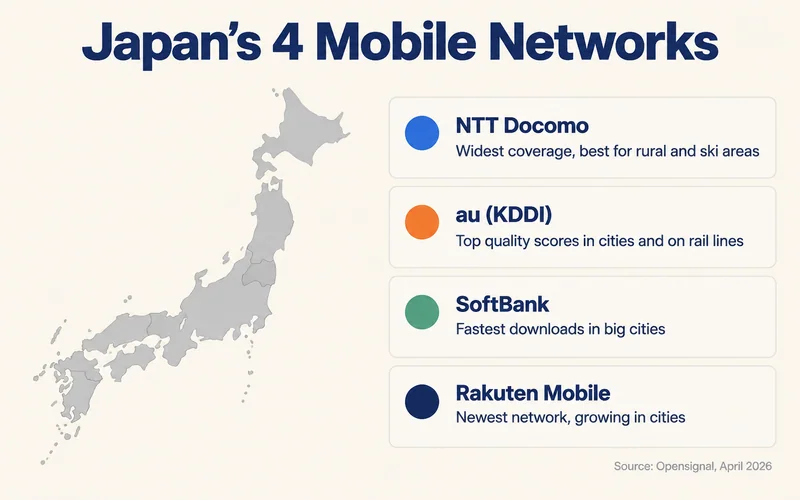
Japan has four mobile networks, not three. A travel eSIM rents capacity from one or more of them, so this matters more than the brand name.
- NTT Docomo: the widest coverage, including mountains, small towns and ski areas. Opensignal's April 2026 report gave it the top awards for overall and 5G coverage. It can feel busier in packed city stations because it has the most users.
- au (KDDI): led most quality categories in the same report, such as video and gaming experience. Very solid in cities and along the main rail lines.
- SoftBank: took the download-speed award. Strong in Tokyo, Osaka and Nagoya, a little patchier in deep rural areas.
- Rakuten Mobile: the newest network, growing fast in cities, still thinner outside them.
A multi-network eSIM picks whichever signal is strongest where you stand, which is why it is the safest default. If your plans include Hokkaido, the Japan Alps, Shikoku or a hiking trail, make sure Docomo is one of the networks.
Is 5G worth paying extra for? Rarely. Japanese 5G is concentrated in city centers and phones drop back to 4G often, even in Tokyo. 4G/LTE is fast enough for maps, video calls and social media, so treat 5G as a bonus rather than a reason to pay more.
4. Do you need a Japanese IP address?
This is the question almost no comparison asks. Many travel eSIMs, including our standard Japan plans, route your traffic through a hub outside Japan (Hong Kong, in our case). You will not notice it for Google Maps, LINE, Instagram, WhatsApp or banking apps.
You will notice it with services that check your location: Japanese TV apps such as TVer, some Japan-only ticket or lottery sites, and the occasional app that is not offered in Hong Kong. If any of those matter to you, choose a plan that exits in Japan. The Japan 20GB IIJ plan runs on Docomo, gives you a Japanese IP and costs the same $13.99.
5. Do you need a Japanese phone number?
Usually not. Travel eSIMs from every major brand are data-only. You call and text through LINE, WhatsApp or FaceTime, and your home SIM stays active next to the eSIM for bank codes and calls from home.
A few situations do need a local number: some restaurant booking sites, certain lottery tickets for concerts or collectible cards, and a long stay where you sign a lease. Japanese voice numbers require an ID check, so providers that sell them (such as Mobal or Sakura Mobile) ask you to apply ahead and deliver the activation code by post or in person. Plan a week or two for that.
For emergencies you do not need a Japanese number: dial 110 for police and 119 for fire or ambulance from your home line.
6. Will your phone take an eSIM?
Most phones from the last few years will: iPhone XS and XR or newer, Samsung Galaxy S20 or newer, and Google Pixel 3 or newer. There are exceptions, including some US-version Galaxy S20 models and most phones sold in mainland China, so check your exact model on the list of eSIM-compatible devices. The phone must also be carrier-unlocked; if you bought it on a contract, ask your carrier before you travel. Recent US iPhones have no SIM tray at all, so for those an eSIM is the only option.
eSIM vs pocket Wi-Fi vs airport SIM in Japan
Japan is the country that made pocket Wi-Fi famous, and airport counters still sell SIM cards. Here is how they stack up in 2026.
| Travel eSIM | Pocket Wi-Fi rental | Airport SIM card | |
|---|---|---|---|
| Typical cost, 2 weeks | $9–$14 for 10–20GB | Daily rental fee, plus delivery or pickup | around ¥4,000 (about $27) for 20GB, per Finding Alexx (2026) |
| Ready when you land | Yes, installed at home | Pick up at a counter or hotel | Queue at the counter |
| Extra device to charge | No | Yes | No |
| Keeps your home number | Yes, side by side | Yes | Only on dual-SIM phones |
| Share with a group | Hotspot from one phone | Best option, up to 5–10 devices | Hotspot from one phone |
| Return needed | No | Yes, by post or at the airport | No |
Pocket Wi-Fi still makes sense for a family where several phones cannot take an eSIM. For everyone else, the eSIM is cheaper and one less thing to lose. Not sure about your phone? See question 6 above.
How to set up your Japan eSIM, step by step
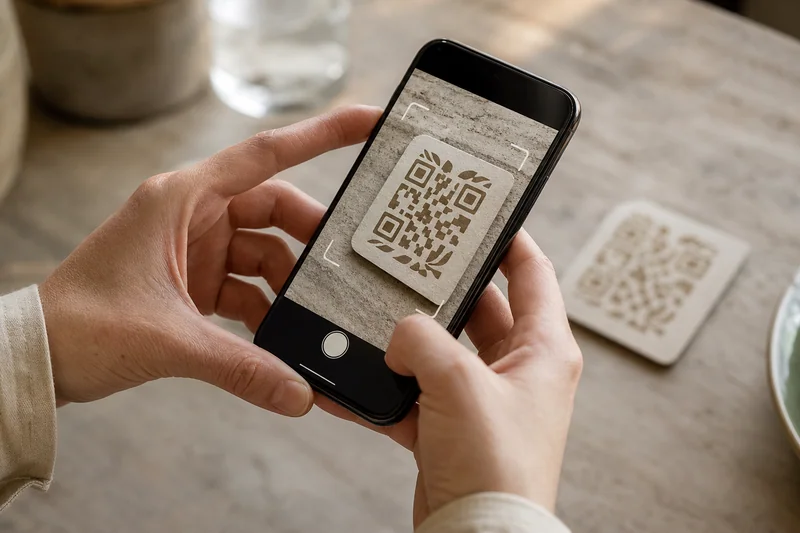
- At home, a day or two before you fly: buy the plan and open the QR code email. On iPhone go to Settings, Mobile Service (or Cellular), Add eSIM. On Samsung go to Settings, Connections, SIM manager, Add eSIM; on Pixel, Settings, Network & internet, SIMs. Scan the code while on Wi-Fi.
- Label it "Japan" so you do not confuse it with your home line, and leave it switched off for now.
- Before takeoff: turn off data roaming on your home SIM so it cannot run up charges.
- After landing: switch the Japan eSIM on, turn on data roaming for it, and choose it as your mobile data line. Keep your home SIM for calls and texts if you want.
- Give it a minute or two. It usually connects on the jet bridge or at immigration. The 30 days start counting from that first connection, not from installation, and you have 180 days after purchase to use it. Not every provider works this way; some start the clock when you scan the QR code, so check before installing early.
Only have one screen? On iPhone, screenshot the QR code and long-press it in Photos. On Android, open Google Lens on the screenshot. For timings in detail, see how long an eSIM takes to activate.
No signal after landing
Check three switches, in this order: the eSIM line is turned on, data roaming is on for that line, and mobile data is set to the eSIM rather than your home SIM. Then restart the phone and wait two to three minutes. Signal on the tarmac is weak, so it often connects only once you reach the terminal.
Connected but slow
On a daily-cap plan, you may simply have hit the limit; it resets the next day. Otherwise go to the eSIM's network settings, turn off automatic network selection and pick another carrier manually. If a 5G connection keeps dropping, switch the line to 4G/LTE, which is steadier outside city centers. More fixes are in our guide to an eSIM that is not working.
Why travelers choose Zyesims for Japan
We are one of the providers in the table above, so read this part with that in mind. The case is simple: Zyesims Japan plans cost around half of the big brands for the same data (20GB for $13.99, 50GB for 30 days at $26.49), connect to all four Japanese networks, and allow hotspot on most plans. If you want to stop thinking about data altogether, Unlimited Premium has no daily speed cap from $15.49 a week.
The QR code is emailed to you once your order is confirmed, validity starts only when you connect in Japan, and support answers at support@zyesims.com within 24 hours. If a fault on our side or the network's stops the eSIM connecting and support can't fix it, you get a full refund (see our refund policy).
Frequently Asked Questions
Is an eSIM a good idea for Japan?
Yes, for almost every visitor. Japan runs on apps: Google Maps for train transfers, translation for menus and signs, and QR codes for tickets and restaurant queues. An eSIM gives you data the moment you land, costs less than an airport SIM or roaming, and keeps your home number active for bank codes. The only travelers who should skip it are those with a carrier-locked or older phone that cannot take an eSIM.
Is Airalo or Ubigi better for Japan?
Both work well in cities and both have strong reputations. Ubigi connects to KDDI and NTT Docomo, which helps outside the big cities, while Airalo uses SoftBank and au (KDDI). On price, neither is the cheapest per GB: in Tokyo Cheapo's August 2026 comparison, Airalo's 20GB for 30 days was about $25 and Ubigi's 25GB about $32, while a Zyesims 20GB 30-day plan is $13.99. Compare the network and the price per GB rather than the brand.
Which network is best for rural Japan?
NTT Docomo. An Opensignal report from April 2026 gave Docomo the top awards for overall and 5G coverage, and it is the network skiers, hikers and onsen-hoppers rely on. If your route includes Hokkaido, the Japan Alps, Shikoku or the Kumano Kodo, choose an eSIM that can use Docomo, either a multi-network plan or a Docomo-only plan such as the Zyesims IIJ range.
Can I get a Japanese phone number with a travel eSIM?
Not with a normal data-only travel eSIM, including those from Zyesims, Airalo, Holafly, Saily and Ubigi. Japanese rules require identity checks for voice numbers, so providers that sell them ask you to apply in advance with ID and send the activation code by post or hand it over in Japan. Most visitors do not need one: LINE, WhatsApp and FaceTime calls run over data, and your home number stays active for SMS codes.
When should I install and activate my Japan eSIM?
Install it at home on Wi-Fi a day or two before you fly, then leave it switched off. Zyesims Japan plans start counting days only when the eSIM first connects to a network in Japan, and you have 180 days from purchase to do that. When the plane lands, switch the eSIM on, enable data roaming for it and select it for mobile data. It usually connects before you reach immigration.
Keep reading
- Best eSIM for Vietnam in 2026: Plans, Networks and Real Prices Compared
- Best eSIM for Europe in 2026: Plans, Coverage and Real Prices Compared
- Best eSIM for USA Travel in 2026: Plans, Networks and Real Prices Compared
- What Is an eSIM? A Complete Beginner's Guide for Travelers (2026)
- eSIM Not Working? How to Fix No Service on iPhone and Android

A travel and tech enthusiast who loves to wander and discover new places. Mihi writes Zyesims' guides to eSIMs and mobile data abroad, built from carriers' and app makers' own documentation, published plan terms and Zyesims' current plan data — with sources named in each article. Mihi also writes about travel at MihiTravel and Notemeeting.
Ready for your next trip?
Choose the right eSIM, get your QR code by email, and connect when you land — coverage in 200+ countries.