South America SIM Card: Local SIM vs Regional eSIM, Prices and Where to Buy (2026)

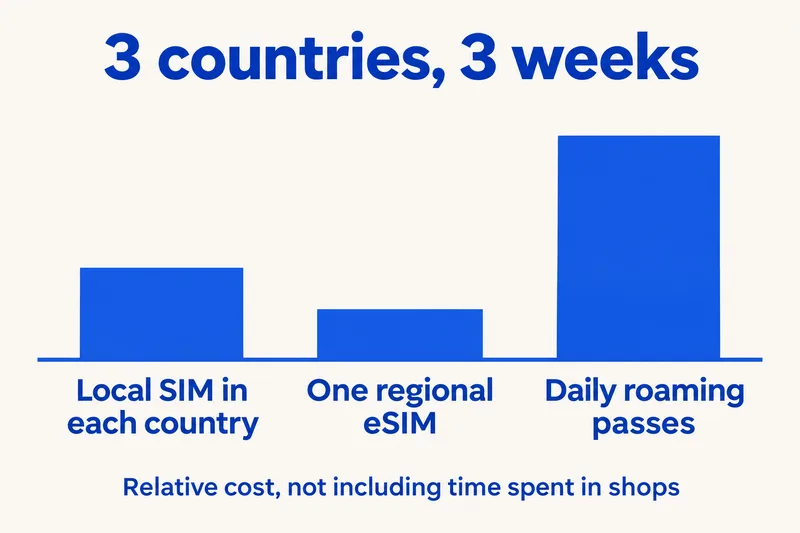
For a trip through several South American countries, the simplest choice is one regional eSIM, from Rp 179,000 for 1GB with Zyesims across Argentina, Brazil, Chile, Ecuador, Peru and Uruguay. A local SIM is cheaper per GB if you stay a month in one country, but you buy a new one at every border, and most shops want a passport, or a CPF in Brazil. Home roaming is the easiest and usually the most expensive.
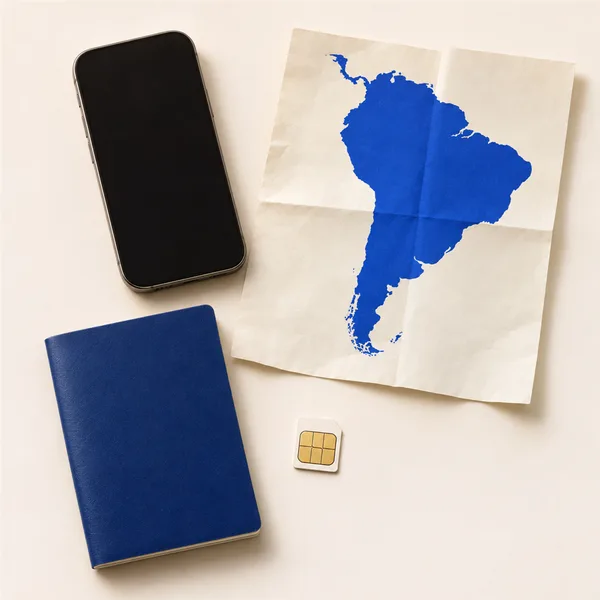
Three countries in three weeks usually means three border crossings, three SIM counters and three new numbers, unless one eSIM covers the whole route. This guide compares the three ways to stay online, then goes country by country: which carriers to look for, what ID shops ask for, where to buy, and what a regional plan really covers. Regional eSIM prices were checked on November 19, 2026.
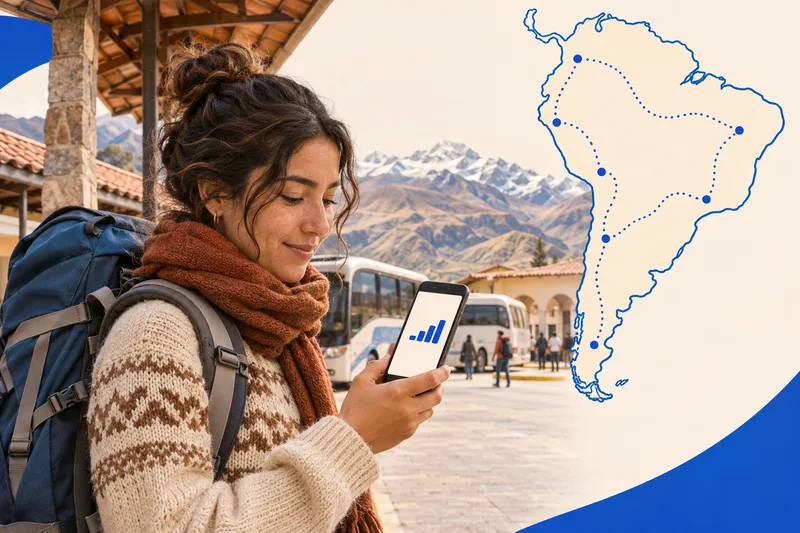
Local SIM, regional eSIM or roaming: what works best in South America?
All three get you online. They differ in how many times you have to set something up, whether you get a local number, and what you pay per GB.
| Option | Works in | Setup | Local number | Typical cost | Best for |
|---|---|---|---|---|---|
| Local prepaid SIM (Claro, Movistar, Entel, TIM, Personal) | One country | Shop visit with passport in each country; phone registration in some | Yes | Lowest per GB, a few dollars to about $15 a month | A month or more in one country |
| Regional eSIM (Zyesims, Airalo, Holafly, Saily) | 6 to 20 countries, depending on the plan | Install at home, switch on when you land | Usually no | From Rp 179,000 for 1GB | Trips that cross two or more borders |
| Home carrier roaming | Wherever your carrier has partners | Nothing, if roaming is on | Your own number | Daily pass from your carrier, often the most expensive | Very short stays, or calls on your home number |
A single-country eSIM sits between the first two: no shop visit, but only one country. It is often cheaper than a regional plan if your trip is mostly in one place, for example a Brazil eSIM from Rp 104,000 for 1GB.
Why one SIM per country gets tiring
A local SIM is tied to its home network. Once you cross into the next country it either roams at high rates or stops working, so a Lima, La Paz, Santiago, Buenos Aires route means four SIM purchases, four ID checks and four top-up systems. Shops also close on Sundays and holidays, and bus borders often cross late at night. That is the main reason travelers on longer routes switch to one regional plan.
Check your phone first
Whatever you choose, the phone must be unlocked, meaning not tied to your home carrier. A travel eSIM also needs an eSIM-capable phone. Keep your home SIM in the phone as a second line for bank codes; our guide on how dual SIM works explains how to run both without paying for roaming.
Buying a local SIM card, country by country
The same few groups run most networks on the continent. Claro, owned by América Movil, operates in Brazil, Argentina, Chile, Colombia, Peru, Ecuador, Paraguay and Uruguay. Movistar (Telefonica) is in Argentina, Chile, Colombia, Peru, Ecuador and Uruguay. Entel is strong in Chile and Peru, TIM and Vivo in Brazil, Personal in Argentina and Tigo in Colombia, Bolivia and Paraguay. A Claro SIM from one country is still a separate account from Claro in the next, so a single brand does not mean a single SIM.
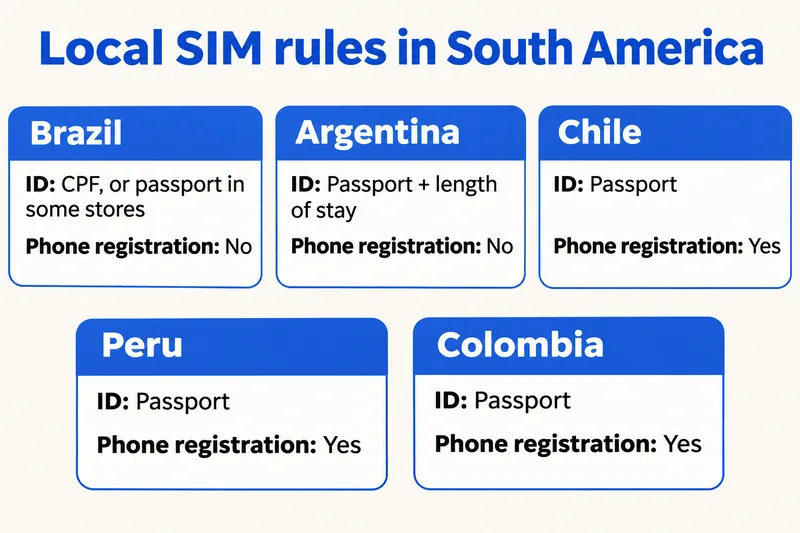
| Country | Main carriers | What shops ask for | Phone registration |
|---|---|---|---|
| Brazil | Claro, TIM, Vivo | Usually a CPF; some stores accept a passport | No separate step |
| Argentina | Claro, Personal, Movistar | Passport and your planned length of stay | No separate step |
| Chile | Entel, Movistar, Claro, WOM | Passport | Yes, IMEI registration for phones bought abroad |
| Peru | Claro, Movistar, Entel, Bitel | Passport, checked in store | Yes, done by the carrier with a signed declaration |
| Colombia | Claro, Movistar, Tigo | Passport | Yes, IMEI linked to your passport by the carrier |
Brazil: the CPF question
Brazilian prepaid lines are registered to a CPF, the national taxpayer number, and many shops will not sell a SIM without one. Some official carrier stores register foreigners with a passport instead. TIM is the carrier travelers most often report success with, Claro depends on the store, and Vivo is usually the strictest. Go to an official carrier shop rather than a newsstand. If you want to skip the question entirely, an eSIM bought online does not need a CPF; see our Brazil eSIM plans.
Argentina: passport and length of stay
Under ENACOM Resolution 263/2023, as reported by The Rio Times in October 2026, foreigners need a valid passport and must declare how long they will stay, and the carrier switches the line off when that period ends. Claro, Personal and Movistar shops handle the registration on the spot. Kiosks sell SIMs too, but you then activate the line yourself. Zyesims also sells Argentina eSIMs on Claro and Movistar.
Chile: register the phone, not only the SIM
Chile requires phones bought abroad to be registered before they run on a Chilean SIM. The official Multibanda site says one phone per person can be registered free each year, and that phones used only in roaming mode do not need registration. Shops can start the process when you buy the SIM, but it is one more step for a short visit. Travel eSIMs connect in roaming mode, so the registration does not apply to Chile eSIMs.
Peru: the carrier registers your phone
Peru's regulator OSIPTEL requires carriers to register phones that people bring from abroad. Staff compare the IMEI printed on the phone with the one shown when you dial *#06#, and you sign a declaration that the phone is for personal use. It is free. If it is not done, the carrier sends an SMS and the phone can be blocked within two business days. Bring your passport; ID checks for foreigners have tightened, so expect the shop to verify it. A Peru eSIM avoids the step.
Colombia: IMEI linked to your passport
Colombia's telecom regulator, the CRC, says a tourist who buys a local SIM must check that the phone is approved for Colombian networks, and carriers link the phone's IMEI to your passport. Phones with two SIM slots or eSIM have two IMEIs, and both may need registering. The process is free, but unregistered phones can have the line blocked. Colombia eSIMs skip it.
Need data for your trip? Compare eSIM plans by validity and data volume.
View eSIM plansWhere to buy a SIM card in South America
Online, before you fly
An eSIM bought online is the only option that works the moment you land. You install it at home over Wi-Fi and turn it on when the plane touches down, so there is no hunting for a shop after a night bus. Physical travel SIMs can also be posted to you, but allow time for delivery. Our guide on how to buy an eSIM online walks through the steps.
At the airport
Large international airports often have carrier stands or phone shops, and staff can register your passport on the spot. Expect a smaller choice of plans and higher prices than in town, and stands that close late at night. Not every carrier has a stand: The Rio Times reported that Claro was not selling at Buenos Aires Ezeiza, while Personal was.
Carrier shops in town
Official Claro, Movistar, Entel, TIM or Personal shops are the safest place to buy a local SIM. They can register your ID and phone, explain top-ups and test the line before you leave. Allow time for a queue, and note that many are closed on Sundays.
Pharmacies, supermarkets and kiosks
Kiosks and pharmacies sell SIMs and top-ups at local prices, which makes them handy for recharging. They usually cannot register a passport or a phone, so the line may stay inactive until you finish registration online or in a carrier shop.
How much does a South America SIM card cost?
Local prepaid bundles are cheap: travel guides in 2026 listed monthly packs in Brazil, Colombia and Chile from about $6 to $11, often with free WhatsApp, and Argentina's tourist packs at roughly $5 to $15. Those prices change with promotions and exchange rates, so treat them as a guide and check at the counter. Add the cost of the SIM itself where shops charge for it.
Regional eSIMs cost more per GB; what you pay for is one setup for the whole route. Provider prices below: November 19, 2026, in US dollars.
| Provider and plan | Countries | Small plan | 5GB, 30 days | 10GB, 30 days | Unlimited | Phone number |
|---|---|---|---|---|---|---|
| Zyesims South America (6 countries) | 6 | 1GB, 7 days: Rp 179,000 | Rp 470,000 | Rp 855,000 | No (daily plans with 1GB a day) | No; Brazil plans with +55 |
| Zyesims South America (20 countries) | 20 | 1GB, 7 days: Rp 244,000 | Rp 826,000 | Rp 1,409,000 | No | No |
| Airalo Latin America | 17 | 1GB, 3 days: $7.00 | $22.00 | $36.00 | 7 days: $39.00 | No |
| Holafly Latin America | 18 | None (unlimited only) | None | None | 7 days: $40.90; 30 days: $99.90 | No |
| Saily Latin America | 12 | 1GB, 7 days: $7.99 | $31.99 | $44.99 | None listed | No |
If most of your trip is in one country, a single-country plan is usually cheaper than any regional one: compare a Zyesims 6-country 5GB plan with 5GB for Brazil alone at Rp 282,000. Tempted by unlimited? Read the fair-use cap first; our comparison of unlimited vs fixed data eSIMs helps you decide whether you need one.
Which countries does a South America plan cover?
"South America" on a plan name rarely means the whole continent. Each provider picks its own list, and a few include Central America, the Caribbean or Mexico instead of every South American country. Check the list against your route, especially if you plan to visit Bolivia, Colombia or Paraguay.
- Zyesims, 6 countries: Argentina, Brazil, Chile, Ecuador, Peru and Uruguay. Colombia and Bolivia are not on this plan.
- Zyesims, 20 countries: Argentina, Bolivia, Brazil, Chile, Colombia, Ecuador, Paraguay, Peru and Uruguay, plus Costa Rica, El Salvador, Guatemala, Honduras, Nicaragua, Panama, Puerto Rico, Guadeloupe, Martinique, Saint Barthelemy and Saint Martin.
- Holafly, 18 destinations: includes Mexico and Belize, and all nine South American countries above.
- Saily, 12 countries: includes Mexico, Bolivia, Colombia and Paraguay.
- Airalo, 17 countries: the full list is shown in its app.
Venezuela, Guyana, Suriname and French Guiana are not covered by any of the Zyesims, Holafly or Saily regional plans. For those, plan on a local SIM or roaming. All Zyesims plans for the region are listed on the Latin America eSIM page.
Do you need a local phone number?
Most travelers do not. Bookings, rides and restaurants across the region run on WhatsApp, which works over data with your usual account. A local number helps when hotels, tour operators or a host call you, when an app insists on a local number, or when you stay for weeks.
Local SIMs always come with a number. Regional eSIMs, including the Zyesims South America plans, are data only. For Argentina, Chile, Peru and Colombia, Zyesims offers data plans only. In Brazil you can add a number with Brazil plans with a +55 number on the TIM network:
- Unlimited calls inside Brazil and 100 SMS.
- From Rp 301,000 for 6GB over 30 days, or Rp 94,000 for a single day with 2GB.
- The 30 days count from purchase, so buy a day or two before you fly.
- No CPF is needed to buy, but the number does not replace one: Pix and Brazilian bank accounts still need your own CPF.
Every plan with a number is listed on our eSIMs with a phone number page.
Which option fits your trip
One country, one or two weeks
Take a single-country eSIM. A 3GB or 5GB plan covers maps, messaging and rides, and it costs less than a regional plan. If that country is Brazil and you need calls, choose a plan with a +55 number.
Two to six countries
One regional eSIM saves a SIM purchase at every border. If your route stays within Argentina, Brazil, Chile, Ecuador, Peru and Uruguay, the 6-country plan is the cheaper of the two Zyesims families. If Colombia, Bolivia or Paraguay are on the route, check that your plan covers them.
A month or more in one place
A local prepaid SIM usually wins on price per GB and gives you a local number. Budget an hour for the shop visit and, in Chile, Peru and Colombia, for registering the phone.
Short stop, calls on your home number
Roaming can make sense for a two-day stopover, or if people must reach you on your usual number. Check your carrier's daily pass price before you go, and read our explainer on what data roaming costs so a long trip does not produce a surprise bill.
Using a Zyesims eSIM in South America
Zyesims sells regional plans for 6 or 20 countries, single-country plans for Brazil, Argentina, Chile, Peru, Colombia and more, and Brazil plans with a +55 number. The QR code arrives by email right after payment. Data plans start counting days when the eSIM first connects to a network, so you can install it at home a few days early and switch it on at your first stop.
Frequently Asked Questions
Is there one SIM card that works in all of South America?
Not one that covers every country. Regional SIMs and eSIMs cover a list of countries, usually Argentina, Brazil, Chile, Peru and Uruguay plus a varying mix of others. Venezuela, Guyana, Suriname and French Guiana are left out of most regional plans, including both Zyesims South America plans. Check the country list against your route before you buy.
Do I need a CPF to buy a SIM card in Brazil?
Brazilian carriers register prepaid lines to a CPF, the national taxpayer number, and many shops ask for one. Some official carrier stores register foreigners with a passport instead, TIM most often, but it depends on the store. A travel eSIM bought online, including the Zyesims Brazil plans with a +55 number, does not need a CPF.
Is an eSIM better than a local SIM for South America?
For a multi-country trip, usually yes: one regional eSIM works across borders, is ready when you land and needs no shop visit or phone registration. A local SIM wins on price per GB if you spend a month in one country and do not mind the paperwork. Your phone must support eSIM and be unlocked either way.
Can I get unlimited data in South America?
Yes. Several providers sell unlimited Latin America eSIMs; Holafly advertised 7 days for $40.90 and Airalo 7 days for $39 on November 19, 2026. These plans slow down after heavy daily use under a fair-use policy. Zyesims sells fixed-data and daily plans for the region rather than unlimited.
Do I need to register my phone in Chile, Peru or Colombia?
Only if you put a local SIM from those countries into a phone bought abroad. Chile, Peru and Colombia each require the phone's IMEI to be registered with the carrier or an approved system, or the line can be blocked. Using roaming, including a travel eSIM that roams on local networks, does not trigger that step.
Keep reading
- What Is Data Roaming? 2026 Costs and Cheaper Alternatives
- What Is a Prepaid SIM Card? How It Works, ID Rules, and Real 2026 Costs
- How Does Dual SIM Work? Pairing a Home SIM with a Travel eSIM
- Unlimited vs Fixed Data eSIM: Which One Actually Fits Your Trip?
- How to Buy an eSIM Online: A Simple Guide for Travelers

A travel and tech enthusiast who loves to wander and discover new places. Mihi writes Zyesims' guides to eSIMs and mobile data abroad, built from carriers' and app makers' own documentation, published plan terms and Zyesims' current plan data, with sources named in each article. Mihi also writes about travel at MihiTravel and Notemeeting.
Ready for your next trip?
Choose the right eSIM, get your QR code by email, and connect when you land: coverage in 200+ countries.