YouTube Blocked in China? Where It Works and How to Watch It (2026)

Yes, YouTube is blocked in mainland China and has been since March 2009. It will not load on hotel Wi-Fi, airport Wi-Fi or a Chinese SIM card. The easiest way to watch it there is a travel eSIM that routes your data through Hong Kong or Singapore, which works without a VPN on mobile data, with plans from about $6 for 5GB. In Hong Kong and Macau, YouTube works normally.

Most visitors only find out at the hotel, when the app spins and nothing plays. This guide explains where YouTube works and where it does not, the three ways travelers get it working in mainland China, how they compare in 2026, and how much data you need if you plan to watch on the go. Facts and prices were checked on October 6, 2026.
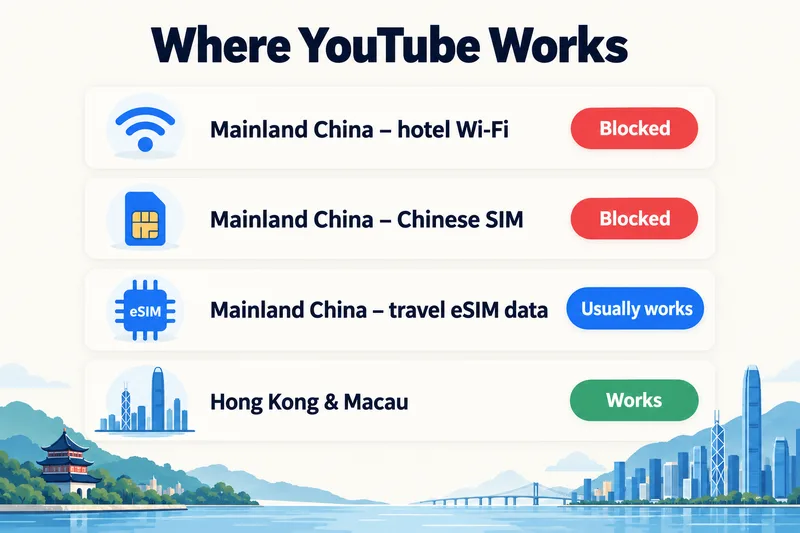
Where YouTube works and where it does not
The block depends on two things: where you are, and which network your data actually leaves through. In mainland China, every connection that exits inside the country passes through the national filter usually called the Great Firewall. That includes the Wi-Fi in a five-star international hotel.
| Where you are and how you connect | YouTube | Why |
|---|---|---|
| Mainland China, hotel, café or airport Wi-Fi | Blocked | Traffic exits in China and is filtered |
| Mainland China, Chinese SIM card | Blocked | Same national filter |
| Mainland China, travel eSIM on mobile data | Usually works | Data exits in Hong Kong or Singapore |
| Mainland China, roaming on your home SIM | Usually works | Data is routed back to your home operator |
| Mainland China, VPN | Unreliable | VPN connections are actively disrupted |
| Hong Kong or Macau, any connection | Works | Separate internet rules, no Great Firewall |
Taiwan also has open internet, so YouTube works there with any SIM or Wi-Fi. If your trip is only Hong Kong, Macau or Taiwan, you do not need any special setup.
Why YouTube is blocked in China
China has blocked YouTube since March 2009. Instead of filtering individual videos, it blocks whole foreign platforms that it cannot regulate locally, and favours domestic services that store data in China and follow Chinese content rules. YouTube is part of a long list: Google Search, Gmail, Google Maps, the Play Store, WhatsApp, Instagram, Facebook, X and Telegram are blocked in the same way.
Because the block happens on the network, nothing on your phone changes it. A different browser, a different YouTube app or a different DNS setting will not help. What helps is making sure your data leaves through a network outside mainland China.
Need data for your trip? Compare eSIM plans by validity and data volume.
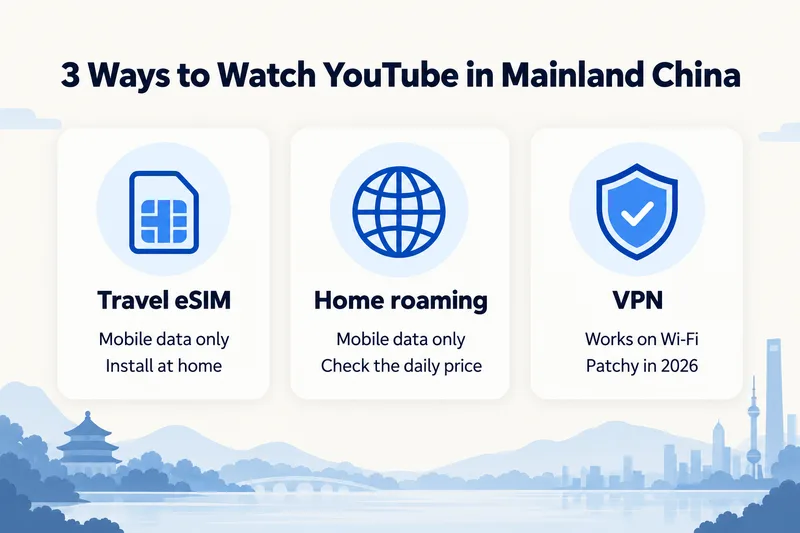
View eSIM plansThree ways to watch YouTube in mainland China
Travelers use one of three methods. Here is how they compare for a typical 1 to 3 week trip.
| Method | Works on hotel Wi-Fi? | Reliability in 2026 | Setup | Typical cost |
|---|---|---|---|---|
| Travel eSIM routed via Hong Kong or Singapore | No, mobile data only | Good | Install at home, 5 minutes | From $5.99 for 5GB at Zyesims |
| Roaming on your home SIM | No, mobile data only | Good | None, if your plan covers China | About $12 a day with a US carrier day pass |
| VPN | Yes, when it connects | Patchy, especially since spring 2026 | Install and test before arrival | Usually $5–15 a month |
Travel eSIM: the simplest option for most visitors
A travel eSIM for China connects to a Chinese network such as China Mobile or China Unicom, but your internet traffic is carried back to the eSIM operator and leaves through its gateway in Hong Kong or Singapore. To the internet you look like a user in that city, so YouTube, Google and WhatsApp open as they would there. This is how international roaming works everywhere, and it is not a VPN.
There are two limits to know. First, it only applies to mobile data. When your phone joins hotel Wi-Fi, YouTube is blocked again, so turn Wi-Fi off or use your phone as a hotspot for a laptop. Second, speeds can be lower than a local SIM because traffic travels to Hong Kong or Singapore and back, which matters more for HD video than for messaging.
Roaming on your home SIM
Your own SIM card behaves the same way: roaming data goes back to your home operator, so YouTube usually works. The catch is price. US carriers' day passes cost about $12 a day (Verizon TravelPass and AT&T International Day Pass both include China, as of October 2026). Without a pass, data is billed per megabyte, and an hour of YouTube can use 0.5–1.8GB. Check your carrier's China rates first, and read our guide on what data roaming costs before you rely on it.
VPN: works on Wi-Fi, but less dependable than it was
A VPN is the only option that can unlock YouTube on hotel Wi-Fi. It is also the least predictable. VPN connections in China drop more often during sensitive dates, and users reported widespread outages after a new crackdown in April 2026, when carriers in parts of China were told to block VPN services. If you rely on one, install it and test it at home, because most VPN websites and app store listings cannot be reached from inside China. Turn it off before paying with Alipay or WeChat Pay, as payment apps can flag VPN connections.
Hong Kong or Singapore exit: does it matter?
For YouTube itself, both work. The difference shows up with other apps, because some services treat a Hong Kong connection differently:
- TikTok left Hong Kong in 2020, so it does not work on a Hong Kong exit. A Singapore exit avoids that.
- ChatGPT and Claude (Gemini opened to Hong Kong users in March 2026) do not officially support Hong Kong, so they may refuse to work on a Hong Kong exit.
- YouTube has geo-blocked 32 videos of a banned protest song in Hong Kong since May 2024, after a court order. Everything else plays normally.
- Streaming catalogues such as YouTube Premium music or Netflix follow the exit country, so the selection may look different.

If you only need YouTube, maps and messaging, a Hong Kong exit is fine and usually cheaper. If you use TikTok or AI tools for work, choose a Singapore exit. Zyesims sells both, labelled on the China eSIM page.
How much data YouTube uses in China
Video is the biggest data user on any trip. These are typical figures per hour of watching; see our full breakdown of how much data YouTube uses for every quality setting.
| Quality | Data per hour | One hour a day for 10 days |
|---|---|---|
| 240p | About 225MB | About 2.2GB |
| 480p | About 560MB | About 5.5GB |
| 720p HD | About 1.8GB | About 18GB |
As a rough guide for a whole trip, a week of maps, messaging and some video uses 5–10GB, and two weeks with daily streaming can pass 20GB. Setting YouTube to 480p on mobile data is the best balance on a small screen. If you plan to watch a lot, a 10GB or 20GB plan is safer than a daily plan, because daily plans slow to 384–512 kbps once the day's allowance is used, which is too slow for video.
Before you fly: set up YouTube for China
- Install your eSIM at home. Many eSIM websites, app stores and VPN pages are blocked or slow from inside China. Turn data roaming on for the eSIM line, as roaming is how it works in China.
- Download videos for the flight and train. YouTube Premium lets you save videos inside the app; they play offline, but Premium needs an internet connection at least once every 30 days to keep downloads.
- Update apps before departure. Updating YouTube or Google apps from the Play Store is not possible on Chinese networks without a workaround.
- Know your fallback. If you will mostly be on hotel Wi-Fi in the evening, decide whether to hotspot from your eSIM or set up a VPN.
- Check your other apps. Gmail, Google Maps and WhatsApp follow the same rules as YouTube, so set them up the same way.
Chinese alternatives to YouTube
Inside China, video runs on domestic platforms that work on any connection: Bilibili (popular for gaming, anime and how-to content), Youku, iQIYI and Tencent Video for series and films, and Douyin, the Chinese version of TikTok, and Kuaishou for short clips. They are fast and free to browse, but most content and menus are in Chinese, and your YouTube subscriptions, playlists and history do not carry over. They are worth a look for local culture, not as a replacement for the creators you follow.
Is it legal to watch YouTube in China as a tourist?
Watching YouTube is not a crime; the site is simply blocked. VPNs that are not government-approved sit in a legal grey area. Enforcement has focused on people selling VPN services and on Chinese users, and few cases involving foreign visitors have been reported. Roaming on a foreign SIM or a travel eSIM is different: it is a standard international telecom service, used by millions of visitors every year. Rules in China can change quickly, so check recent traveler reports before you go.
Using a Zyesims eSIM for YouTube in China
Our China eSIM plans come in two lines. The Hong Kong exit line runs on China Mobile, with a 5GB, 30-day plan for $5.99 and 10GB for $9.99. The Singapore exit line, labelled "nonhkip", runs on China Unicom and China Telecom, with a 10GB, 30-day plan for $11.99; pick it if you also need TikTok or AI tools. Most plans start counting days when they first connect in China, not when you buy them.
To be clear about the limits: our China plans are data-only with no Chinese phone number, so they cannot receive SMS codes from Chinese apps; the YouTube access applies only on mobile data, not on Wi-Fi; and video in HD uses data quickly. If you are also visiting Hong Kong, our Hong Kong eSIM or an Asia plan may be better value than two separate eSIMs.
Frequently Asked Questions
Is YouTube still blocked in China in 2026?
Yes. YouTube has been blocked in mainland China since 2009, and that has not changed in 2026. The block covers the app, the website and embedded videos, on hotel Wi-Fi, airport Wi-Fi and Chinese SIM cards alike. YouTube works normally in Hong Kong and Macau.
Can I watch YouTube in China with an eSIM?
Usually yes, on mobile data. Most travel eSIMs for China roam on a Chinese network but send your traffic out through Hong Kong or Singapore, where YouTube is not blocked, so it loads without a VPN. It only works while you are on the eSIM's data. As soon as your phone switches to hotel Wi-Fi, YouTube is blocked again.
Does YouTube work on hotel Wi-Fi in China?
No. Hotel, café and airport Wi-Fi in mainland China all pass through the national filter, so YouTube almost never loads, even in international hotel chains. To watch on Wi-Fi you would need a working VPN. The simpler option is to turn Wi-Fi off and use a travel eSIM's data, or share it from your phone as a hotspot.
Is it illegal for tourists to watch YouTube in China?
Watching YouTube is not itself a crime; the site is simply blocked. Unapproved VPNs sit in a legal grey area; enforcement has targeted VPN sellers and Chinese users, and few cases involving foreign visitors have been reported. Roaming on a foreign SIM or travel eSIM is a normal telecom service, not a VPN. Rules can change, so check before you travel.
Does YouTube work in Hong Kong and Macau?
Yes. Hong Kong and Macau have their own internet rules and YouTube works there on any Wi-Fi or SIM, with no setup. Since May 2024, 32 videos of a banned protest song have been geo-blocked in Hong Kong after a court order, but the platform itself is open.
Keep reading
- How Much Data Does YouTube Use? MB per Hour by Quality (2026)
- How Much Data Does Streaming Use? Netflix, YouTube, Live Sport and Music (2026)
- Can You Hotspot with an eSIM? Limits, Data Use and Fixes for Travelers
- What Is Data Roaming? 2026 Costs and Cheaper Alternatives
- How to Buy an eSIM Online: A Simple Guide for Travelers

A travel and tech enthusiast who loves to wander and discover new places. Mihi writes Zyesims' guides to eSIMs and mobile data abroad, built from carriers' and app makers' own documentation, published plan terms and Zyesims' current plan data — with sources named in each article. Mihi also writes about travel at MihiTravel and Notemeeting.
Ready for your next trip?
Choose the right eSIM, get your QR code by email, and connect when you land — coverage in 200+ countries.