Does WhatsApp Work in Russia? 2026 Status, Telegram and What to Use Instead

No, WhatsApp does not work in Russia in 2026. Roskomnadzor blocked it nationwide on February 11–12, 2026, after cutting WhatsApp calls in August 2025. A travel eSIM no longer gets around the block: since July 10, 2026, roaming traffic is filtered like Russian traffic. Plan to use phone calls, iMessage or another app that still works, and tell your contacts before you leave.
This guide gives the status of WhatsApp, Telegram and other messaging apps in Russia as of October 6, 2026, explains why a foreign SIM or eSIM stopped helping in July, and lists what tourists actually use to stay in touch. Russian rules have changed every few months since 2025, so check the date on anything you read.
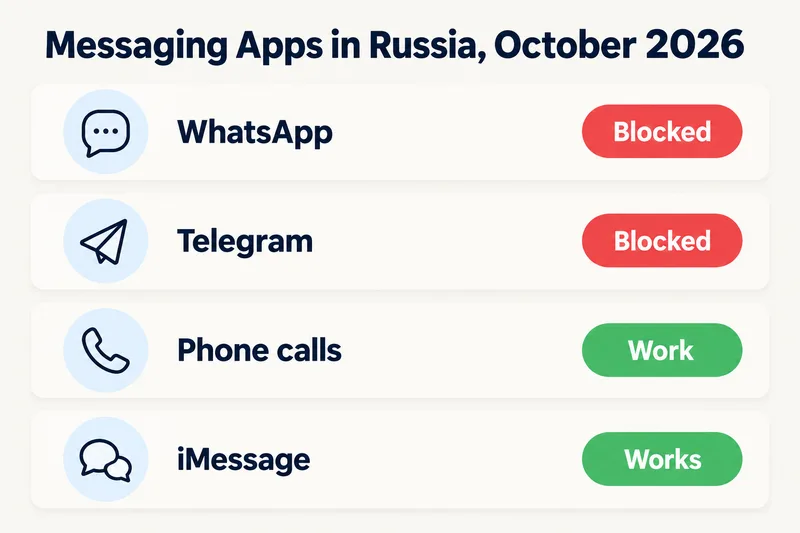
Does WhatsApp work in Russia right now?
Officially, no. On February 11–12, 2026, Roskomnadzor, Russia's communications regulator, removed WhatsApp's domains from the national domain name system and added network-level filtering on top. The Kremlin confirmed the block and pointed users to Max, a state-backed messenger. WhatsApp said the move was "a backwards step" for more than 100 million users in Russia.
In practice, the picture is messier. Some users in Russia report that WhatsApp occasionally connects without any workaround and then drops again, which Russian tech writers put down to uneven filtering rather than any change in policy. Voice and video calls have been restricted since August 2025 and rarely connect.
For a traveler, the useful conclusion is simple: do not plan your trip around WhatsApp. If it happens to work for a few minutes, treat that as a bonus.
How we got here: the WhatsApp timeline
| Date | What changed |
|---|---|
| August 13, 2025 | Voice and video calls on WhatsApp and Telegram restricted; text still worked |
| November 28, 2025 | Roskomnadzor announces "gradual" restrictions and threatens a full block |
| From December 22, 2025 | WhatsApp reportedly slowed by 70–80%; photos and videos often fail |
| February 11–12, 2026 | Full nationwide block; the Kremlin points users to Max |
| July 10, 2026 | Roaming traffic from foreign SIMs and eSIMs filtered like Russian traffic |
| October 2026 | Still blocked; some users report occasional, unpredictable connections |
Why a travel eSIM no longer fixes WhatsApp in Russia
Until mid-2026, a foreign SIM was the easiest workaround. Roaming data was usually carried back to the home operator before it reached the internet, so Russian filters never saw it and WhatsApp loaded as if you were abroad. That is still how roaming works in China, where a travel eSIM routed via Hong Kong opens YouTube and WhatsApp.
Russia closed that gap. Problems started in early July, and on July 10, 2026 the Ministry of Digital Development confirmed that roaming traffic of foreign subscribers is now filtered under the same rules as local users. What counts is where you are, not where your SIM comes from. Our own Russia plans are no exception, and neither is any other travel eSIM.
Some eSIM sellers still advertise Russia plans that "restore access to WhatsApp" without a VPN, including pages updated after July 10. Treat those claims with caution: they describe how things worked before the change. Services that left Russia voluntarily, such as Netflix, may still open on a foreign eSIM, because Russia never blocked them in the first place.
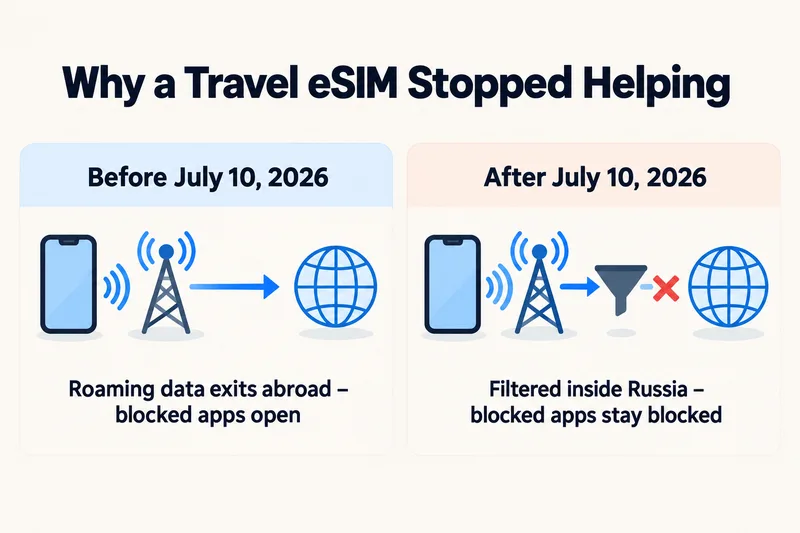
Need data for your trip? Compare eSIM plans by validity and data volume.
View eSIM plansTelegram and other messaging apps in Russia
WhatsApp is not the only app affected. Here is the status of the apps travelers ask about most, as of October 6, 2026.
| App | Status in Russia | Since |
|---|---|---|
| Blocked | February 2026 (calls since August 2025) | |
| Telegram | Blocked for most users, unreliable | Mid-March 2026 (calls since August 2025) |
| Signal | Blocked | August 2024 |
| Viber | Blocked | December 2024 |
| Discord | Blocked | October 2024 |
| FaceTime | Restricted | December 2025 |
| Snapchat | Blocked | Announced December 2025 |
| Facebook Messenger, Instagram DMs | Blocked | March 2022 |
| Google Meet | Unreliable | August 2025 |
| iMessage | Generally works | No official block |
| WeChat, LINE | Work | No block |
| VK Messenger, Yandex Messenger, Yandex Telemost | Work | Russian services |
| Max | Works, but needs an eligible phone number | State-backed, launched 2025 |
| Ordinary phone calls | Work | Including during the 24-hour block on foreign SIMs |
Skype is missing from the list because Microsoft shut it down worldwide in May 2025.
Telegram in detail
Telegram is the app Russians themselves used most, which is why its block hit hardest. Calls were cut in August 2025, the app was throttled from February 10, 2026, and from mid-March 2026 most connection attempts failed. Access came back briefly in late March, and in April it worked again for a small share of Android users after Telegram changed its app, not because the block was lifted. In early October 2026, users were still reporting delayed messages and media that would not load. Like WhatsApp, Telegram is filtered on travel eSIMs too since July.
Max: the state messenger, and who can sign up
Max is a messenger built by VK and backed by the Russian state. Since September 1, 2025 it must come pre-installed on phones sold in Russia, and officials have pushed it as the WhatsApp replacement. For visitors, the catch is registration: according to VK in March 2026, Max accepts phone numbers from about 40 countries, including Russia and the CIS countries, Vietnam, Thailand, Indonesia, the UAE and Turkey. We found no evidence that US, UK or EU numbers are accepted. A data-only travel eSIM has no phone number, so you would register with your home SIM if your country is on the list. WhatsApp itself calls Max a surveillance app, so weigh what you share on it.
How tourists stay in touch in Russia
Most visitors manage fine once they stop expecting WhatsApp. These are the options that work, roughly in order of convenience.
- Ordinary phone calls. They work on any SIM, including during the first 24 hours when foreign SIMs have no data or SMS. Check your home carrier's roaming call rates, which can be high.
- iMessage between iPhones. It has not been blocked and works over mobile data or Wi-Fi. FaceTime, by contrast, has been restricted since December 2025.
- WeChat. Works normally and is a good choice if your contacts already use it.
- Yandex Messenger and Telemost for chats and video calls with Russian hosts, guides or business contacts.
- Email. Unglamorous but dependable for bookings and confirmations.
- Max, if your phone number is from an eligible country.
- Your host or hotel's phone number and email. Many Russian landlords and short-term rental hosts moved from WhatsApp and Telegram to Max or plain calls, so ask for a number and an email when you book.
Should you install a VPN before you go?
Many travelers do, because VPN websites and app store listings are hard to reach once you are inside Russia. It is not a guaranteed fix: Russia has blocked hundreds of VPN services and many common VPN protocols, so a VPN that works one day may fail the next. If you use one, install it at home, test it, and have a second option ready. Turn it off when you open the operator's link to lift the 24-hour block, which only loads without a VPN. We do not recommend specific VPN services.

Three other things that cut you off in Russia
Even apps that are not blocked can fail for reasons that have nothing to do with WhatsApp. Plan for these as well.
No data or SMS for the first 24 hours
Since October 6, 2025, every foreign SIM and eSIM loses mobile data and SMS for 24 hours after it first connects to a Russian network. Calls still work, and the network texts you a captcha link that usually restores data within minutes. Our guide to lifting Russia's 24-hour data block walks through the steps.
Public Wi-Fi asks for a phone number
Russian law requires public Wi-Fi, including at airports, to identify users by phone number, usually with an SMS code. On your first day that text may not arrive, and a data-only eSIM has no number at all. Hotel Wi-Fi with a room password is the most dependable fallback.
Regional mobile internet shutdowns
Russian authorities switch off mobile internet in specific regions, sometimes for weeks, leaving only a whitelist of services such as Yandex, VK and Russian banks. Moscow had a long outage in March 2026 and St Petersburg was cut back to the whitelist on July 10, 2026. No SIM or eSIM gets around this; Wi-Fi usually keeps working.
Is it illegal to use WhatsApp or a VPN in Russia?
Using WhatsApp is not an offence for an individual; the app is blocked, not banned for users. Using a VPN is also not illegal for individuals. Two newer rules matter, though. Since September 1, 2025, Russia fines people 3,000–5,000 rubles for deliberately searching for material on its official list of extremist content, including when they use a VPN, and fines individuals 50,000–80,000 rubles for advertising VPN services. We found no reports of tourists being fined simply for using WhatsApp. Laws in Russia change quickly, so check recent guidance from your government's travel advice before you go.
Before you fly: a short checklist
- Tell family and colleagues that WhatsApp may not work, and agree on a backup: phone calls, iMessage, WeChat or email.
- Back up your WhatsApp chats and save key contacts' phone numbers in your phone book, not only inside the app.
- Install and sign in to the apps you will rely on at home. App stores and many websites are slow or blocked in Russia.
- Buy and install your travel eSIM at home, since foreign cards do not work for payments in Russia, and learn how to lift Russia's 24-hour data block on foreign SIMs.
- Save bookings offline as screenshots or PDFs in case messaging fails at a key moment.
What a Zyesims eSIM does and does not do in Russia
Our Russia eSIM plans give you mobile data on the T2 and Beeline networks, for maps, ride-hailing, email, iMessage and the apps that are not blocked. A 5GB, 30-day plan costs $8.99 as of October 6, 2026. The plans are data-only with no Russian phone number, they face the same 24-hour block as every foreign SIM, and since July 10, 2026 they do not unblock WhatsApp, Telegram or other blocked apps. We would rather you know that before you buy. If messaging matters, our guide on whether texting uses data explains which message types need a data connection and which do not.
Frequently Asked Questions
Is WhatsApp banned in Russia in 2026?
Yes. Russia's regulator Roskomnadzor blocked WhatsApp nationwide on February 11–12, 2026, after restricting its voice and video calls in August 2025. The block has not been lifted as of October 2026. The app sometimes connects for short periods because the filtering is uneven, but you cannot rely on it for messages, and calls almost never work.
Will WhatsApp work in Russia with a travel eSIM?
Not any more. Until mid-2026, foreign SIMs and travel eSIMs often got around Russian blocks because roaming traffic was routed abroad. Since July 10, 2026, Russia filters roaming traffic under the same rules as local traffic, so WhatsApp is blocked on a travel eSIM just as it is on a Russian SIM or hotel Wi-Fi.
Does Telegram work in Russia?
Not reliably. Telegram calls have been restricted since August 2025, the app was throttled from February 10, 2026 and blocked for most users from mid-March 2026. Access has returned briefly a few times, but in early October 2026 users still report messages arriving late and media not loading.
Is it illegal for tourists to use WhatsApp or a VPN in Russia?
Using WhatsApp or a VPN is not itself an offence for individuals. Since September 1, 2025, Russia fines people 3,000–5,000 rubles for deliberately searching for content on its official extremist list, including through a VPN, and fines anyone who advertises VPNs. We found no reports of tourists being fined just for using WhatsApp.
What messaging app should I use in Russia as a tourist?
Ordinary phone calls work, and iPhone users report that iMessage keeps working. WeChat and Yandex Messenger also work. Russia's state-backed app Max accepts phone numbers from about 40 countries, including Vietnam, Thailand and Kazakhstan, but not, as far as we found, the US, UK or EU. Agree on a backup with your contacts before you fly.
Will my WhatsApp number change if I use a travel eSIM?
No. WhatsApp stays linked to your home phone number. A data-only travel eSIM just supplies the internet connection, so your account, chats and contacts do not change. Keep your home SIM active in the phone if you might need WhatsApp's SMS verification code, and note that SMS is blocked on foreign SIMs during the first 24 hours in Russia.
Keep reading
- Russia eSIM 24-Hour Data Block: Why It Happens and How to Lift It (2026)
- YouTube Blocked in China? Where It Works and How to Watch It (2026)
- Does Texting Use Data? SMS, MMS, RCS, iMessage and WhatsApp Explained
- Does FaceTime Use Data? How Much per Call, Abroad and on Wi-Fi (2026)
- How to Buy an eSIM Online: A Simple Guide for Travelers

A travel and tech enthusiast who loves to wander and discover new places. Mihi writes Zyesims' guides to eSIMs and mobile data abroad, built from carriers' and app makers' own documentation, published plan terms and Zyesims' current plan data — with sources named in each article. Mihi also writes about travel at MihiTravel and Notemeeting.
Ready for your next trip?
Choose the right eSIM, get your QR code by email, and connect when you land — coverage in 200+ countries.