What Is a Prepaid SIM Card? How It Works, ID Rules, and Real 2026 Costs

A prepaid SIM card flips the usual order of a phone plan. The money goes first, the service follows, and nothing lands in your inbox at the end of the month. No contract, no credit check, and the line goes quiet the moment the allowance is gone. Travel versions typically run a week, a fortnight, or 30 days, and what you pay depends almost entirely on where you buy: roughly $79 for 3GB at a San Francisco airport kiosk, or $4.49 for the same 3GB bought as a travel eSIM before you leave home.
Most people searching this term are trying to settle one question: how is prepaid different from a normal mobile plan? The short version is that it is not a different kind of card. It is a different way of paying. Below we cover how prepaid works step by step, what it costs on a real trip, which countries demand your passport before they will activate it, and when a travel eSIM does the job better.
What Is a Prepaid SIM Card?
Money moves first, service follows. You hand a carrier a fixed amount, it hands back an allowance, and the number stays live until that allowance is spent. Top up and the clock restarts. Do nothing and it simply stops. That ordering is the entire concept, and it is why these plans also get labelled pay-as-you-go.
What sits inside the allowance varies by provider. Some plans are pure data. Others bundle minutes and texts on top. Nearly all of them carry a clock as well as a counter, and on travel products that clock is usually set to a week, a fortnight, or a month. Data-only is the default choice for trips now, since messaging and calls ride over data anyway.
The one rule that defines prepaid
Strip away the marketing and a single rule does all the work: the carrier is never owed anything. You cannot run up a balance, because there is no balance to run up. Everything else follows from that, including the missing credit check, the missing contract, and the missing bill to argue about.
The flip side is just as blunt. A line that cannot go into debt also cannot carry you past zero. When the counter empties or the clock expires, whichever lands first, the service ends there.
Is the card itself any different?
No. The plastic is identical and the same tray fits both. Any standard SIM can sit on prepaid billing one month and a monthly account the next. Nothing in the chip decides it; the arrangement attached to the number does.
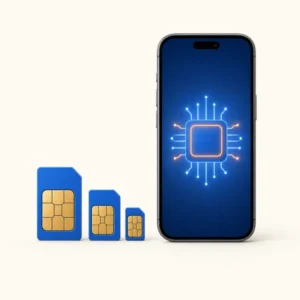
This is why the size question is separate from the payment question. Nano, micro, and embedded profiles are all just form factors, and we break those down in our guide to SIM, nano SIM, and eSIM differences. A nano SIM can be prepaid; an eSIM can be prepaid. Neither fact tells you anything about the other.
How Does a Prepaid SIM Card Work?
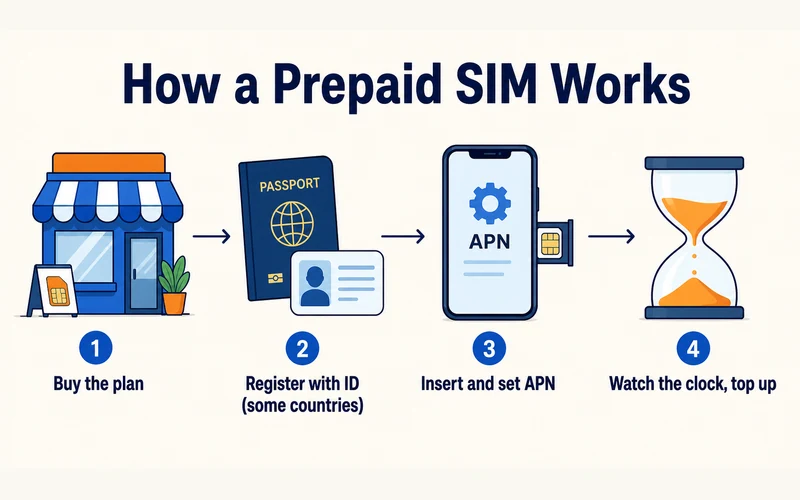
In practice it is four steps: buy, activate, insert, and monitor. Each one has a place where people get stuck, so here is what to actually watch for.
Step 1: Choose where you buy
Carrier stores, supermarkets, convenience chains, airport kiosks, and online sellers all stock them. Four things are worth confirming before you hand over money: does the allowance cover voice and SMS or only data, how many days the clock runs, whether the country wants to see your passport, and what topping up would actually involve once you are there.
Price varies enormously by channel, and the airport is almost always the worst one. More on that below.
Step 2: Register and activate
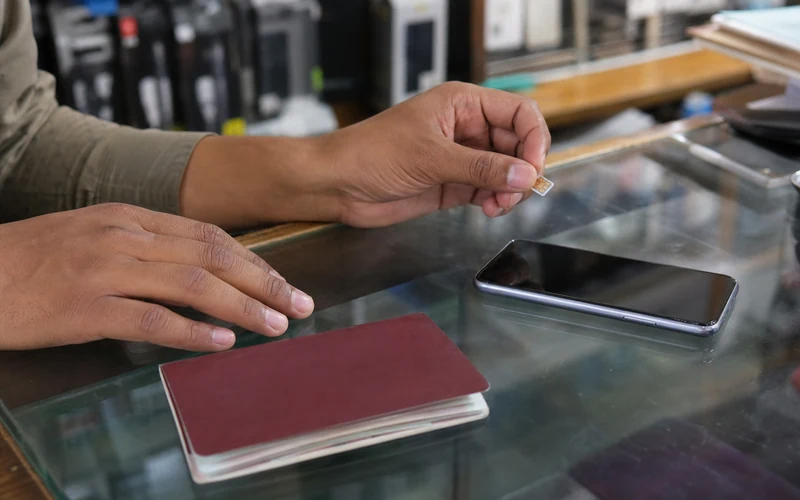
Some SIMs activate the moment you insert them. Others need a call to a service number, an online form, or an in-store registration with an ID document. In countries with real-name rules the shop assistant will scan your passport and the line will not work until that clears, which can take anywhere from a few minutes to a few hours.
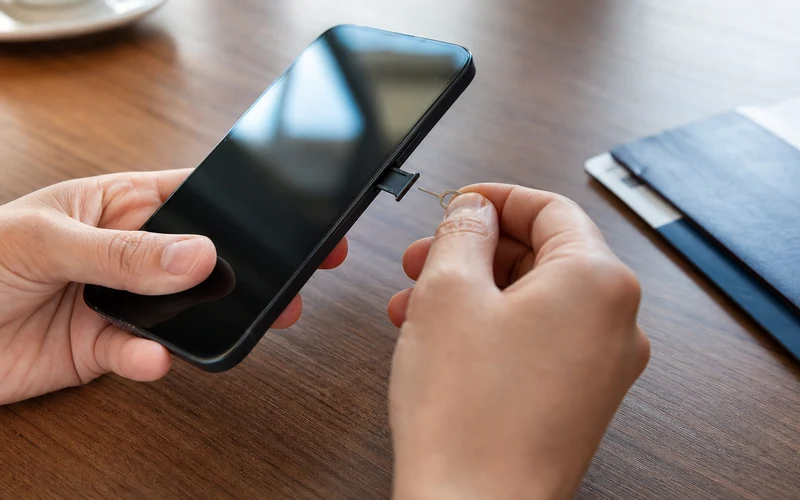
Step 3: Insert the SIM and connect
The handset has to be carrier-unlocked, meaning no single network has a claim on it. On iPhone the check lives at Settings > General > About > Carrier Lock, and you want it to read "No SIM restrictions." Handsets bought outright are usually clear; ones financed through a carrier often stay locked until the last instalment clears.
Give it a minute or two. If data still has not come alive, the usual culprit is the APN, the access point name that tells your phone which gateway to route data through. Most providers publish theirs, and you enter it under mobile network settings. If you are running the prepaid line alongside your home number, our guide to how dual SIM works covers which line to set as default for data.
Step 4: Track usage and top up before it expires
Check your remaining data in your phone settings or the provider's app, not by guessing. Two things end a prepaid plan: running out of data, or hitting the end of the validity window. Both stop service, and unused data rarely rolls over.
There is a third deadline people miss. If you stop topping up entirely, most carriers suspend the line and then recycle the number after roughly 30 to 90 days of inactivity. For a travel SIM you will never use again that is fine. For a backup line you want to keep, a small top-up every couple of months protects the number.
Need data for your trip? Compare eSIM plans by validity and data volume.
View eSIM plansPrepaid vs Postpaid: What Actually Changes
Both give you the same network and the same signal. The difference is the commitment and where the risk sits.
| What you care about | Prepaid | Postpaid |
|---|---|---|
| When you pay | Before you use it | Monthly bill, after use |
| Contract | None | Usually 12 to 24 months |
| Credit check | No | Almost always |
| Bill surprises | Impossible | Possible, especially roaming |
| Runs out mid-trip | Yes, unless you top up | No, it keeps going |
| Best for | Travel, backup lines, tight budgets, kids | Heavy daily use, one household bill, subsidised handsets |
Postpaid also tends to carry perks that prepaid does not: bundled streaming, device financing, family plan discounts. If you live somewhere permanently and use a lot of data every day, postpaid is often the cheaper and simpler choice. Prepaid wins when your use is temporary, unpredictable, or somewhere you do not live.
Do You Need ID to Buy a Prepaid SIM Card?
This is the step travelers get caught out by, and most guides skip it. A growing number of countries tie every prepaid line to an identity document, and the rules differ enough that "just grab a SIM at the airport" is bad advice in about half the world.
Countries that require real-name registration
As of July 2026, activation requires an ID document across most of Europe and Asia-Pacific: France, Spain, Italy, Germany, Portugal, Belgium, Switzerland, Greece, Poland, Turkey, South Korea, China, Hong Kong, Singapore, Malaysia, Thailand, Vietnam, Indonesia, the Philippines, India, and Australia. In practice that means a passport scan at the counter and a short wait.
China is the strictest of the group: registration must happen in person at a carrier store, with your passport, and there is no online path for visitors. Japan sits in an unusual middle position, where data-only SIMs and eSIMs can be issued without ID but anything with voice or SMS requires registration. That quirk is one reason a data-only Japan eSIM is such a clean option for short trips there.
Countries with no legal requirement
The United States, Canada, the United Kingdom, Ireland, the Netherlands, and New Zealand have no national registration mandate. You can walk in, pay, and walk out. Individual carriers may still ask for details for fraud screening, but it is their policy rather than the law. Mexico dropped off this list in 2026: since 9 January, new lines must be linked to a CURP, or a passport for visitors.
Does an eSIM skip registration?
Not automatically, and this is a common misconception. An eSIM is a digital profile, but the mobile line behind it still sits under local telecom law. Where registration is mandatory, it still applies. What changes is the method: many European operators accept a video ID check or a document upload for eSIM activation instead of a store visit, which is faster but not the same as being exempt.
What a Prepaid SIM Really Costs on a Trip
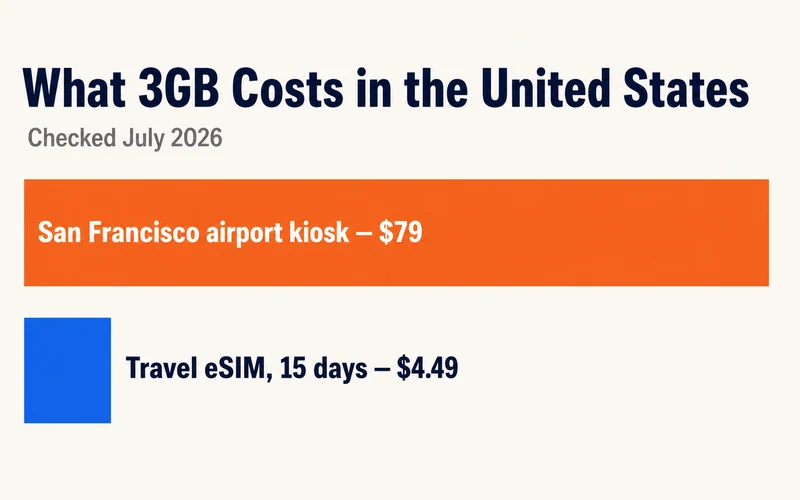
Here is where the numbers get uncomfortable. The same 3GB of data can cost you $79 or $4.49 depending purely on where you buy it. Prices below were checked in July 2026, using the United States as the example market.
| Where you buy | Typical price | What you get | Catch |
|---|---|---|---|
| Airport kiosk | ~$79 + tax | 3GB | Captive-audience pricing, often 30–50% above the same plan in town |
| Carrier store (T-Mobile, Verizon prepaid) | $45 | 15GB, 30 days | Cheaper per GB, but you pay for a full month even on a 5-day trip |
| Supermarket or big-box store | ~$40 + tax | 10GB | Best physical-SIM value; expect $50–75 all-in for the first month with SIM fee and tax |
| Travel eSIM (Zyesims) | $4.49 | 3GB, 15 days | Data only, and your phone must support eSIM |
The gap is not a rounding error. A carrier prepaid plan makes sense if you are staying a month and want a local number for calls. For a one-week trip you are buying 30 days of service and throwing away three weeks of it. Zyesims plans for the same market run $11.49 for 10GB over 30 days, $6.49 for 5GB, and $1.99 for 1GB over 7 days, with the entry plan at $0.89. Browse the full range on the United States eSIM page.
How much data do you actually need?
The most common way to overpay is buying data you will never touch. Rough daily figures for a traveler on hotel and cafe WiFi at night: maps and navigation use about 5MB per hour, messaging apps a few MB a day, and social feeds 100–300MB per hour if you scroll video.
That puts most sightseeing trips at 300–500MB a day, so 3GB comfortably covers a week and 5GB covers ten days. Buy 10GB or 20GB only if you stream, work remotely, or plan to tether a laptop. If you are unsure, start small and top up. Topping up costs a few dollars; over-buying costs you the whole difference.
Prepaid SIM or Travel eSIM?
Both are prepaid in the billing sense. The difference is physical card versus digital profile, and each still has a genuine use case.
When a physical prepaid SIM still wins
Choose the physical card when your phone does not support eSIM, when you need a local phone number for calls and SMS from banks or delivery apps, when you are staying long enough for a local monthly plan to beat per-day pricing, or when you are heading somewhere with poor coverage from international providers and want the strongest local network.
When an eSIM is the better call
Choose the eSIM when you want to land already connected, when the trip is short enough that a full local month is wasteful, when you want to keep your home number active for verification codes on the same phone, or when you would rather not queue at an airport kiosk after a long flight. Installing takes a few minutes and can be done before you fly; our walkthrough on how to buy an eSIM covers the whole process, and typical activation takes under five minutes.
One thing both options solve is the same problem: not letting your home carrier bill you at international rates. If you keep your normal SIM active abroad without a plan, that is data roaming, and it is the most expensive way to get online.
Why Zyesims
Zyesims sells prepaid connectivity without the parts of prepaid that annoy people. Plans start at $0.89, and larger plans work out to well under $1 per GB, so you are not paying a convenience premium for landing at an airport. Coverage runs across 200+ destinations, and you install before you fly, which means no counter, no queue, and no passport scan in a language you do not read.
Validity is stated on every plan in plain numbers, 7, 15, 30, 90, or 180 days, so nothing hides in the small print. And because it is a data profile rather than a card, your home number stays active on the same phone for two-factor codes and calls from family.
Frequently Asked Questions
Do prepaid SIM cards expire?
Yes, on two separate timers. Each plan carries a countdown, typically a week to a month on travel products, and the line goes quiet the moment either that countdown or the data counter hits zero. The second timer runs slower: leave a number unused for 30 to 90 days and the carrier will generally take it back. Unused gigabytes almost never survive into the next plan, so size the purchase to the trip rather than to the discount.
Do I need a passport to buy a prepaid SIM card?
It depends on the country. The United States, Canada, the UK, Ireland, the Netherlands, and New Zealand have no legal registration requirement. France, Spain, Italy, Germany, Turkey, India, Australia, Singapore, Thailand, Vietnam, Indonesia, and South Korea all require real-name registration with an ID document. China is the strictest: you register in person at a carrier store with your passport.
Can I keep my phone number on a prepaid SIM?
Usually yes, if you are switching carriers inside the same country. You port the number across rather than activating a fresh one, and it typically takes a few days. Keep the old line active until the port completes. A prepaid SIM bought abroad for travel gives you a new local number instead, which is why most travelers keep their home number on their main line and use a data-only plan for internet.
Is a prepaid SIM cheaper than a travel eSIM?
For long stays a local prepaid SIM bought in a regular store can win on raw price. For short trips the eSIM is usually cheaper, because you pay for exactly the days you need and skip the airport markup. As of July 2026 a 3GB SIM at San Francisco airport runs about $79 plus tax, while a Zyesims 3GB 15-day plan for the United States is $4.49.
Do I need an unlocked phone for a prepaid SIM?
Yes, for a physical prepaid SIM from a different carrier. Unlocked means the phone is not tied to one network. On iPhone check Settings > General > About > Carrier Lock, which should read "No SIM restrictions." Travel eSIMs are held to the same requirement, and when data refuses to start after connecting, the usual fix is typing the APN in manually.
Keep reading
- SIM vs Nano SIM vs eSIM: Key Differences and Which One to Choose
- What Is an eSIM? A Complete Beginner's Guide for Travelers (2026)
- What Is Data Roaming? 2026 Costs and Cheaper Alternatives
- Do eSIMs Expire? What Runs Out, When, and How to Check (2026)
- Best eSIM for USA Travel in 2026: Plans, Networks and Real Prices Compared

A travel and tech enthusiast who loves to wander and discover new places. Mihi writes Zyesims' guides to eSIMs and mobile data abroad, built from carriers' and app makers' own documentation, published plan terms and Zyesims' current plan data — with sources named in each article. Mihi also writes about travel at MihiTravel and Notemeeting.
Ready for your next trip?
Choose the right eSIM, get your QR code by email, and connect when you land — coverage in 200+ countries.