Russia's Mobile Internet Shutdowns and Whitelist (2026): What Travelers Need to Know

Since May 2025, Russia has regularly switched off mobile internet region by region, and during these shutdowns only a whitelist of approved Russian services keeps working, such as Gosuslugi, Yandex, VK, Ozon and Russian Railways. Foreign SIMs and travel eSIMs run on the same Russian networks, so expect them to lose data too. Hotel and other fixed-line Wi-Fi usually keeps working, and there is no official schedule, so travel with offline maps, cash and saved bookings.

This is now one of the biggest practical issues for anyone visiting Russia, and most travel guides barely mention it. This guide explains how the shutdowns and the whitelist work, how much of the country is affected, what still works during an outage, what it means for a travel eSIM, and how to prepare. Facts were checked on October 10, 2026; the situation changes week to week.
What is happening: shutdowns and whitelists explained
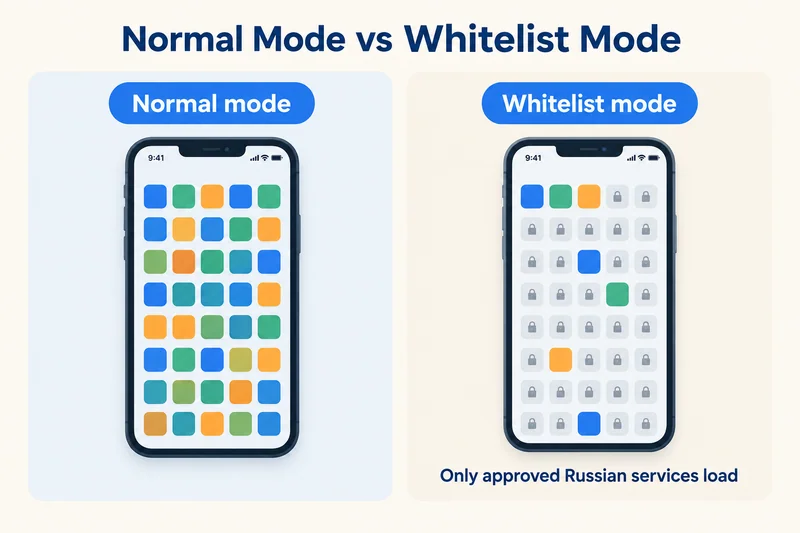
A shutdown is when mobile operators in a region stop providing mobile internet, sometimes for hours, sometimes for days or weeks. In 2025 they were usually full cut-offs, though often only in parts of a city. Since autumn 2025, authorities increasingly use whitelist mode instead: mobile data still works, but only for services on an approved list. Everything else, including most foreign websites and apps, fails to load.
| Date | What happened |
|---|---|
| May 2025 | Shutdowns begin before Victory Day, hitting dozens of regions |
| June–July 2025 | Monitoring project Na Svyazi counts 655 shutdowns in June and 2,099 in July |
| September 2025 | First official whitelist, reported at 57 services; updated many times since |
| March 2026 | Law 33-FZ (signed in February) takes effect, obliging operators to cut service on the security service's demand |
| March 2026 | Central Moscow loses mobile internet for about a week, then runs in whitelist mode until around March 24; St Petersburg hit from March 9 |
| May 9, 2026 | Victory Day restrictions in Moscow include whitelisted sites and SMS |
| July 10, 2026 | St Petersburg and Leningrad Oblast switched to whitelist-only mobile internet |
By the research firm Top10VPN's count, Russia had more hours of internet shutdowns in 2025 than any other country, at 37,166 hours. By March 2026, independent monitors had recorded shutdowns in nearly every Russian region.
How much of Russia is affected
The clearest picture comes from network data Kommersant reported in August 2026, based on about a billion mobile sessions. By one summary of that data, more than 60% of mobile sessions nationwide ran with restrictions in the first half of 2026. It varies a lot by region:
| Area | Share of mobile sessions without restrictions |
|---|---|
| Central Federal District (July 2026) | About 30.5% |
| Moscow and Moscow Oblast (late July 2026) | About 49% |
| St Petersburg (late July 2026) | About 44% |
| Border regions such as Bryansk, Kursk and Belgorod | About 12% |
| Least restricted, e.g. Jewish Autonomous Oblast, Tuva, Magadan (June 2026) | About 69–76% |
In other words, in Moscow and St Petersburg, the cities most visitors see, roughly half of mobile connections were running under restrictions in summer 2026.
Need data for your trip? Compare eSIM plans by validity and data volume.
View eSIM plansWhat still works during a shutdown
The whitelist is maintained by Russia's Ministry of Digital Development and has grown to well over a hundred services. According to Kommersant's March 2026 summary, it includes:
- Government: Gosuslugi and official government websites.
- Russian platforms: Yandex services, VK, Odnoklassniki, Mail.ru, the Max messenger, VK Video and Rutube.
- Maps and transport: 2GIS, Russian Railways (RZD), Tutu, Aeroflot, Pobeda, and car-sharing services such as Yandex Drive.
- Shopping and delivery: Ozon, Wildberries, Avito, Megamarket, Russian Post, CDEK and Samokat.
- Payments and banks: the Mir payment system and banks such as VTB, Alfa-Bank and PSB. Whether Sber and T-Bank are included has been disputed.
- Mobile operators' own websites and apps.
Not on the list: WhatsApp, Telegram, Google services, YouTube, foreign news sites and most other foreign websites and apps, which are blocked or unreliable in Russia anyway. We found no foreign bank apps or eSIM providers' websites on published versions of the list. Even whitelisted apps do not always work: during the Moscow shutdowns, residents reported failing taxi and banking apps, card terminals and ATMs in some districts.
Does a travel eSIM keep working during a shutdown?
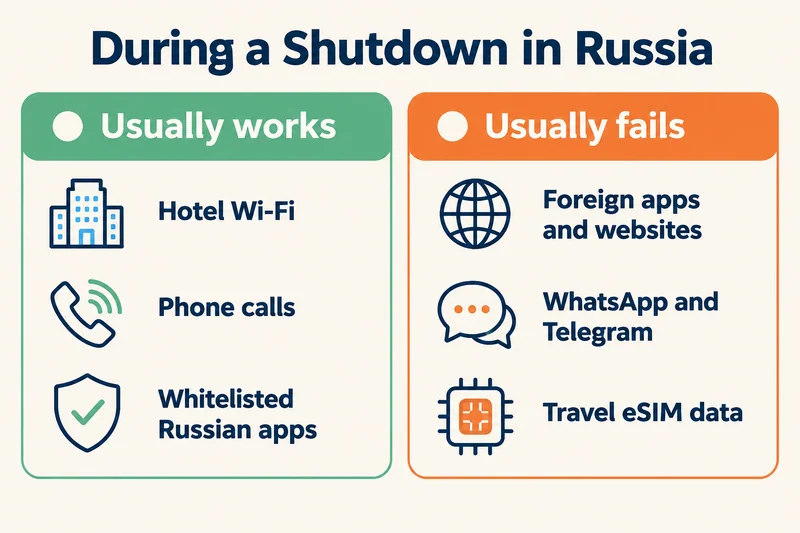
Usually not, and this is the point most eSIM sellers leave out. A travel eSIM or a roaming home SIM connects through the same Russian mobile networks as a local SIM. When a region's mobile internet is cut, your eSIM loses data along with everyone else. We found no source showing roaming connections getting special treatment in whitelist mode, so plan as if you will have no mobile data, or at best the same whitelist-only access, during an outage. This comes on top of two other rules for foreign SIMs: the 24-hour data and SMS block when you first arrive, explained in our guide to Russia's 24-hour data block, and the filtering of roaming traffic since July 10, 2026.
| Connection | Normal day | During a shutdown or whitelist mode |
|---|---|---|
| Travel eSIM or roaming foreign SIM | Works after the 24-hour block; blocked apps stay blocked | Expect no data, or whitelist-only at best |
| Russian SIM | Works | Whitelisted services only |
| Hotel or home Wi-Fi (fixed line) | Works | Usually works |
| Public Wi-Fi | Works after phone-number login | Often works, if you can log in |
| Phone calls and SMS | Work (SMS blocked for 24 hours on new foreign SIMs) | Usually work, but were also restricted in Moscow on May 9, 2026 |
Wi-Fi during a shutdown
Shutdowns target mobile networks, so fixed-line connections such as hotel, apartment and café Wi-Fi usually keep working. That makes your hotel the best place to check messages, plan the day and download anything you need. There have been exceptions, including fixed-line outages in Moscow in spring 2026, so do not rely on it completely. Public Wi-Fi in the metro and on the street needs a phone-number login, which can be tricky with a foreign SIM; our guide to Wi-Fi in Russia explains which networks accept foreign numbers.
Why Russia does this
The official reason is security, specifically protection against drones that may use mobile networks for navigation; the Kremlin said in March 2026 that the shutdowns are legal and will last as long as needed for security. Critics question that link: an analysis by The Insider found that only 78 of at least 230 confirmed shutdowns in May and June 2025 coincided with drone attacks. Since March 2026, Law 33-FZ has required operators to suspend service when the FSB security service demands it, without any court involvement, and shields them from liability to customers.
Is there a schedule or warning?
No. Russia's Ministry of Digital Development has declined to send SMS warnings, citing security reasons. It occasionally announces restrictions for big events, such as Victory Day, on its channel in the Max messenger, and some regional governors post notices. Independent projects such as Na Svyazi publish counts and maps only after the fact. In practice, a shutdown shows up as full signal bars but no data, or only Russian apps loading.
How to prepare for a trip to Russia
- Download offline maps for every city on your route in Yandex Maps or 2GIS; 2GIS works offline without an account. Our guide to Russia travel apps lists what to install.
- Carry cash rubles. Card terminals and ATMs can fail during outages, and foreign Visa and Mastercard cards do not work in Russia anyway.
- Save everything offline: hotel address in Russian, tickets, booking confirmations and a screenshot of your route.
- Agree on meeting points and times with travel companions, since messaging may fail.
- Keep your home SIM active for calls, which usually keep working when data does not.
- Use hotel Wi-Fi in the morning to check for news of restrictions and plan the day.
- Expect the 24-hour block on arrival and know how to clear it.

What a Zyesims eSIM can and cannot do
Our Russia eSIM plans give you mobile data on the T2 and Beeline networks from CN¥30.89 for 1GB over 7 days, with a 5GB, 30-day plan for CN¥78.99. To be clear about the limits: when a region's mobile internet is switched off, our eSIM loses data along with every other SIM on those networks, it does not unblock apps Russia has blocked, and it faces the same 24-hour block on arrival. It is useful for the days and places where mobile internet works, which is still most of the time in most regions, but it cannot replace offline preparation.
Frequently Asked Questions
Why is mobile internet not working in Russia?
Most likely because of a regional shutdown or whitelist mode. Since May 2025, Russian authorities have regularly switched off mobile internet in specific regions, officially for security against drones. In whitelist mode only approved Russian services load. If you have just arrived on a foreign SIM, it may also be the 24-hour block on new foreign SIMs.
What is Russia's internet whitelist?
It is a list of approved services, maintained by the Ministry of Digital Development, that stay reachable when mobile internet is restricted. It includes Gosuslugi, Yandex, VK, Max, Ozon, Wildberries, Russian Railways, 2GIS and several Russian banks. Foreign apps such as WhatsApp, Telegram and Google are not on it.
Does a travel eSIM work during a mobile internet shutdown in Russia?
Generally no. A travel eSIM connects through Russian mobile networks, so when a region's mobile internet is cut, the eSIM loses data too. Expect no data, or whitelist-only access at best. Hotel and other fixed-line Wi-Fi usually keeps working during shutdowns.
Does Wi-Fi work during internet shutdowns in Russia?
Usually yes. Shutdowns target mobile networks, so hotel, apartment and café Wi-Fi on fixed lines generally keeps working, although there have been occasional fixed-line outages. Public Wi-Fi requires a phone-number login, which can be difficult with a foreign SIM.
Which cities in Russia have mobile internet shutdowns?
Almost all of them at some point: by March 2026, independent monitors had recorded shutdowns in nearly every region. Moscow and St Petersburg had major episodes in 2026, and border regions such as Bryansk, Kursk and Belgorod are restricted most of the time. There is no official schedule.
Will calls and SMS work during a shutdown?
Usually yes, which makes ordinary calls the most reliable way to reach people. But not always: Moscow's Victory Day restrictions on May 9, 2026 included SMS, and some residents lost calls during outages. New foreign SIMs also cannot receive SMS for their first 24 hours in Russia.
Keep reading
- Wi-Fi in Russia for Tourists (2026): Free Networks, Login Rules and Day-One Tips
- Russia eSIM 24-Hour Data Block: Why It Happens and How to Lift It (2026)
- Does WhatsApp Work in Russia? 2026 Status, Telegram and What to Use Instead
- Russia Travel Apps 2026: What to Download, What Works and How to Pay
- Russia SIM Card for Tourists in 2026: Local SIM Rules, Operators and eSIM Prices

A travel and tech enthusiast who loves to wander and discover new places. Mihi writes Zyesims' guides to eSIMs and mobile data abroad, built from carriers' and app makers' own documentation, published plan terms and Zyesims' current plan data, with sources named in each article. Mihi also writes about travel at MihiTravel and Notemeeting.
Ready for your next trip?
Choose the right eSIM, get your QR code by email, and connect when you land: coverage in 200+ countries.