


Anonymous eSIM in 2026: How to Get Travel Data Without ID Verification

Yes, you can get mobile data abroad without handing over a passport. Travel eSIMs are sold as data products, so no ID check, no document upload, and no verification stands between you and a working connection. Zyesims plans start at $0.89, checkout runs as a guest with no account to create, and setup takes about five minutes. What skipping the ID check does not do is make your phone invisible, and this guide is straight about where that line falls.
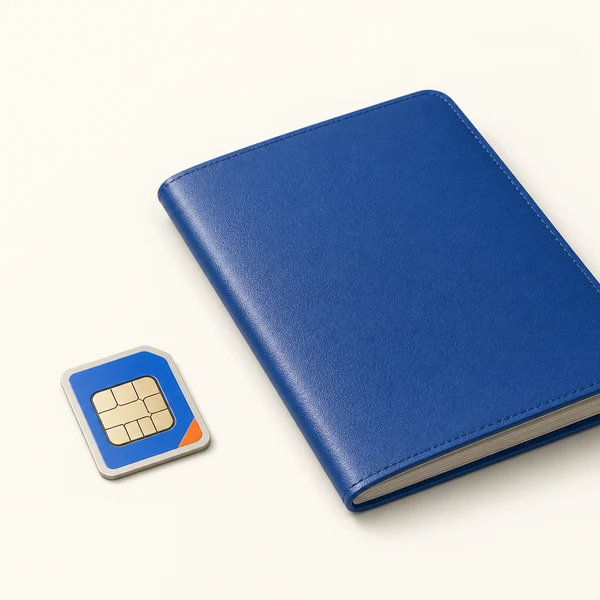
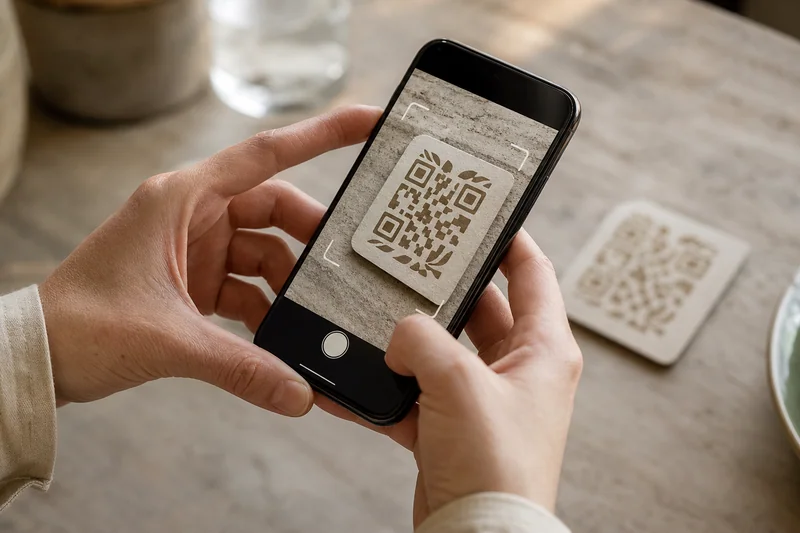
People arrive at this topic from two directions. Some are tired of the passport scan at an airport counter and the account that comes with it. Others have a specific reason to keep a connection separate from their name. Both deserve a clear answer rather than marketing, so below you will find what the term covers, how to actually buy one, what it protects, and the countries where registration is still required by law.
What Counts as an "Anonymous" eSIM
There is no standard behind the word, so sellers use it to mean different things. Four levels cover the market, and knowing which one you need saves you both money and disappointment.
The four levels of eSIM privacy
Level 1: no identity check. Nobody asks for a passport, national ID, or selfie. You still give an email so the QR code can reach you. This is where mainstream travel eSIMs sit, Zyesims included, and it is what the large majority of buyers are actually looking for.
Level 2: no account, no email. The profile is issued without a login and delivered on the order page itself. This closes the gap where your address ends up on a mailing list.
Level 3: crypto payment. The purchase is no longer tied to a card in your name. Monero conceals sender, receiver, and amount through ring signatures; Lightning keeps the payment off-chain instead.
Level 4: full stack. The eSIM sits alongside a VPN, a rented number for SMS codes, and a device that has never carried your usual accounts. At this point the eSIM is a small part of a much larger setup.
Anonymous, private, and pseudonymous are different claims
Anonymous means no identity was ever attached. Pseudonymous means an identity exists but it is not your legal one, which is what most "anonymous" checkouts actually produce once an email is involved. Private means a company does hold data on you but limits what it collects and how long it keeps it.
Knowing the difference protects you at the point of purchase. If a seller uses all three words interchangeably, read their retention policy before you rely on the claim.
Ways to Get Data Abroad, and What Each One Asks For
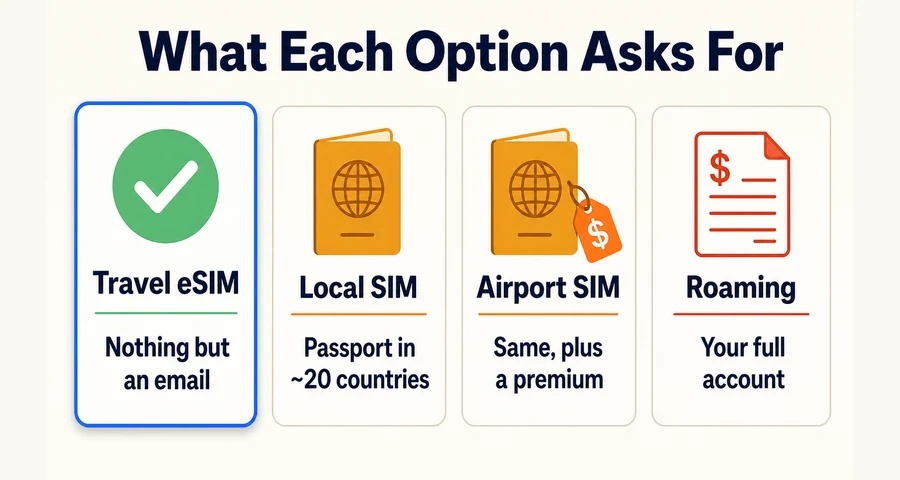
The eSIM is not the only option, but it is the only one that reliably asks for nothing. Here is how the four common routes compare, with prices checked in July 2026.
| Option | ID required | Tied to your name | Typical cost, 3GB | Where you set it up |
|---|---|---|---|---|
| Travel eSIM | No | Email only | $3.99–4.49 | At home, before you fly |
| Local prepaid SIM | Often yes, depends on country | Yes where registration applies | $40–45 for a monthly plan | A shop at your destination |
| Airport kiosk SIM | Same rules as local SIM | Yes where registration applies | Up to $79 | Arrivals hall, after a long flight |
| Home carrier roaming | Already verified | Fully, it is your own account | Varies, billed to your name | Nothing to set up |
Roaming is the least private option by definition, since the connection runs on the account your carrier already holds full identity records for. A local SIM sits in the middle: private from your home carrier, but registered with a foreign one in the roughly twenty countries that require it. The travel eSIM is the only route where no counter, no clerk, and no document sits between you and a working connection.
Need data for your trip? Compare eSIM plans by validity and data volume.
View eSIM plansWhy People Buy an eSIM Without ID
The reasons are ordinary more often than not, and they are all valid.
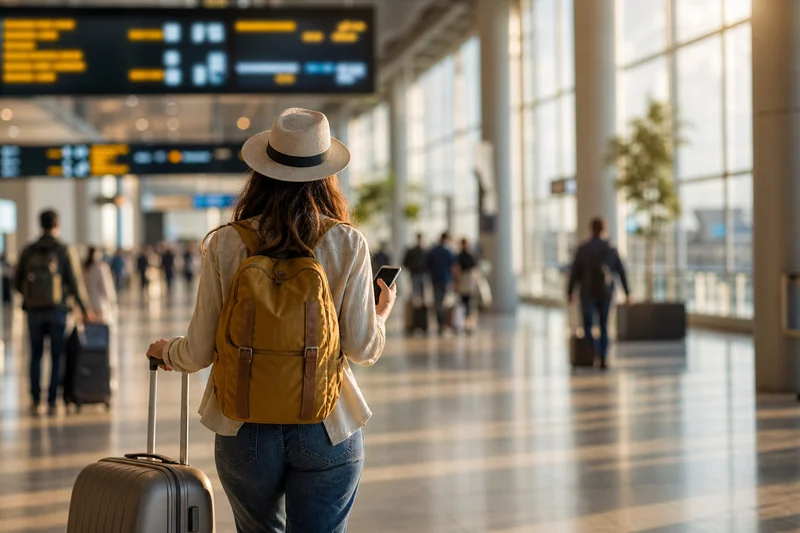
Skipping the counter. The most common one by far. After a long flight, finding the kiosk, queuing, handing over a passport, and waiting for a registration to clear is an hour nobody wants. Installing at home removes the whole errand.
Keeping a trip separate from your main line. A second profile for travel means your primary number stays free for banking codes and family calls, and the trip does not generate a new registration under your name in a foreign system.
Not adding another company to the list. Every registration is one more organisation holding a copy of your passport, under privacy rules you have not read and cannot enforce from abroad. Fewer copies is a reasonable preference on its own.
Work that requires separation. Journalists, researchers, and people handling sensitive commercial matters often need a connection that is not trivially linkable to their main identity. For this group the eSIM is one part of a wider setup that also includes a VPN and a device kept clear of familiar accounts.
Who Sells eSIMs Without an ID Check in 2026
Two groups serve this market. Mainstream travel eSIM providers sit at Level 1 by default, because they sell data rather than phone lines and never had a reason to ask for documents. A smaller set of specialists build for Level 2 and above, dropping email and accepting only crypto.
The details below are what each provider advertises as of July 2026. These are self-reported claims from companies selling privacy, so verify anything you intend to rely on.
| Provider | Level | Account / email | Payment | Advertised coverage | Notable |
|---|---|---|---|---|---|
| Zyesims | 1 | No account, email required | Card checkout (Stripe) | 200+ destinations | Plans from $0.89; the low-cost end of the range |
| Silent.Link | 3 | Neither | Crypto only (BTC, Lightning, Monero) | 160+ countries | Balance never expires; longest-running and priciest |
| PikaSim | 2–3 | No account; email only if paying by card | Crypto, plus cards via Stripe | 190+ countries | Self-hosted payment server |
| nadanada | 3 | Neither | Crypto | 200+ countries | Bundles VPN and rented numbers; offers an API |
| ZeroID | 3 | Neither | Crypto | Not published | No email or phone number at any stage |
| VoidMob | 3 | Neither | Crypto, several coins | Not published | Combines eSIM, SMS numbers and mobile proxies |
What the extra levels cost
Dropping the email and the card trail carries a real price difference. For a comparable 3GB plan in Europe, PikaSim lists around $12.99 for 7 days and Silent.Link roughly $18 to $20 in crypto. A Zyesims 3GB Europe plan is $3.99 and runs 15 days, so Level 3 costs roughly three to five times more for half the validity.
Which is correct depends entirely on what you are protecting. If a seller holding your email address is part of your threat model, that premium is buying you something specific and the specialists are built for it. If the passport scan at the counter was the thing you wanted gone, Level 1 already solved it and the extra spend buys nothing you will notice.
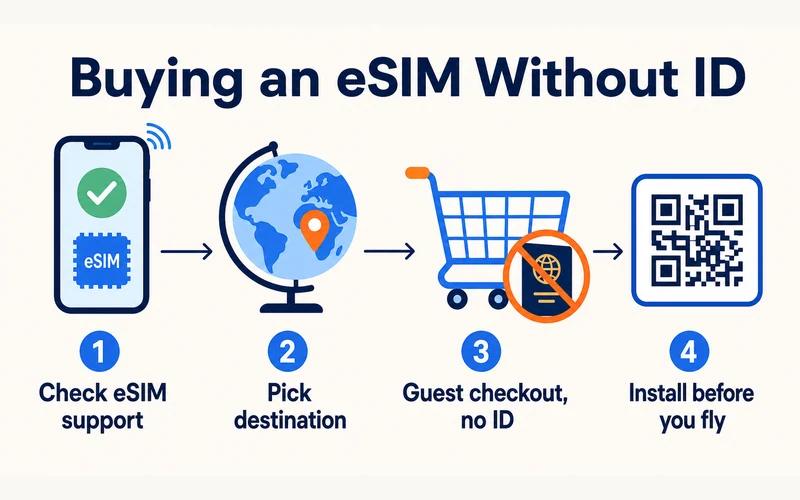
How to Buy an eSIM Without ID Verification
The process is shorter than most people expect, and none of it involves a document.
Step 1: Check your phone supports eSIM
Every iPhone from the XS onward, recent Pixels, and most flagship Samsung and Android models support eSIM. The phone also has to be carrier-unlocked. On iPhone that check lives at Settings > General > About > Carrier Lock, and you want it to read "No SIM restrictions."
Step 2: Pick a destination and a plan size
Buy for the trip rather than the discount. Maps and messaging run around 300 to 500MB a day for a typical sightseeing trip, so 3GB comfortably covers a week and 5GB covers ten days. A 3GB Europe plan covering 35 countries runs $3.99 for 15 days, and single-country plans start lower. You can browse everything on the destinations page.
Step 3: Check out as a guest
No account is created at Zyesims checkout, so there is no profile to maintain or delete afterwards. You enter an email address, because the QR code has to arrive somewhere, and pay by card; the payment is processed by Stripe. There is no passport upload, no document review, and no waiting for verification to clear.
Step 4: Install before you fly
Scan the QR code while you are still on home WiFi. On most plans the days only start counting when the eSIM first connects at your destination; a small number of plans start counting from installation, so check the plan details (or ask us) before installing early. This is the part that removes the airport queue entirely, and our full buying and setup walkthrough covers the screens on both iOS and Android.
What Skipping the ID Check Does Not Cover
Worth reading before you buy, so the product you get matches what you wanted. None of the following changes based on how you paid or whether anyone checked your ID.
Your IMEI
The IMEI is the serial number built into the handset, not the SIM. Swapping profiles does not touch it. If that same phone has ever carried a line registered in your name, the hardware identifier already links them.
The carrier's network logs
Connecting to a mobile network means telling that network roughly where you are. The operator records which towers your device used and when. That is how the technology works rather than a policy choice, and it applies to every SIM and eSIM equally.
Your IP address
Without a VPN, every site you open sees the IP your carrier assigned, which places you in a country and often a city. Worth knowing: budget providers frequently route traffic back through distant infrastructure before it reaches the open internet, which affects both your apparent location and your latency. Our guide to data roaming explains how that routing works.
Your phone's own telemetry
iOS and Android report diagnostics and location signals to Apple and Google on their own schedule, tied to your device and accounts. If you stay signed into the accounts you always use, the SIM underneath makes little difference to that.
Getting More Privacy From Any eSIM
Most of the available gain comes from how you use the connection, not from who sold it.
Run a VPN. The single biggest change available to you. It hides traffic from the carrier and replaces the carrier-assigned IP that every site would otherwise see.
Prefer data-only plans. A profile with no voice or SMS attached carries lighter registration obligations in several countries and gives you no phone number to be correlated against. Messaging and calls run over data anyway.
Keep your primary accounts signed out. Logging into your usual mail and social accounts re-attaches your identity within minutes, whatever the SIM underneath.
Reset the advertising identifier and revoke background location. Both iOS and Android allow this, it costs nothing, and it closes a tracking channel the SIM never touched.
Where Registration Laws Still Apply
Buying data without showing ID is an ordinary consumer transaction across most of the world. The United States, Canada, the United Kingdom, Ireland, the Netherlands, and New Zealand have no national SIM registration mandate. Mexico dropped off this list in 2026: since 9 January, new lines must be linked to a CURP, or a passport for visitors.
Around twenty countries do require real-name registration by law, among them France, Spain, Italy, Germany, Portugal, Turkey, Poland, South Korea, Singapore, Malaysia, Thailand, Vietnam, Indonesia, the Philippines, India, and Australia. China is strictest, requiring in-person registration at a carrier store. Japan is the useful exception: data-only profiles can be issued without ID while voice and SMS lines require registration, which is one reason a data-only Japan eSIM suits short trips there so well.
The practical takeaway is that an eSIM is not a way around a local statute, and several European operators simply moved the check online rather than dropping it. For the country-by-country picture, including how this differs from buying a physical SIM at a counter, see our guide to prepaid SIM cards and where you need your passport.
Why Zyesims Works for This
If your goal is mobile data without an identity check, Zyesims meets that directly. There is no passport upload, no document review, and no verification step of any kind. Checkout runs as a guest, so no account is created and nothing needs deleting afterwards.
Plans start at $0.89 and cover 200+ destinations, with regional bundles like the United States or 35-country Europe letting one purchase replace a separate registration in every market you pass through. Validity is printed in plain numbers on every plan, 7, 15, 30, 90 or 180 days, so nothing renews behind your back.
To be straight about the boundary: an email address is required, because the QR code has to be delivered, and your card details go to the payment processor (Stripe) at checkout. That places Zyesims firmly at Level 1, which is exactly what most travelers are looking for when they search for this.
Frequently Asked Questions
Can I buy an eSIM without ID verification?
Yes. Travel eSIMs are sold as data products, so most providers never ask for a passport, national ID, or selfie check. You pick a destination and a plan, pay, and the QR code arrives. Zyesims works this way: no document upload and no identity check at any point, with plans from $0.89.
Do I need an account or email to buy an anonymous eSIM?
An account, usually not. Zyesims checkout runs as a guest, so no profile is created and there is no password to manage later. An email address is still needed, because that is how the QR code and activation instructions reach you. A small number of specialist privacy providers deliver on the order page itself and skip email too, at a significantly higher price.
Is buying an eSIM without ID legal?
In most markets, yes. The United States, Canada, the UK, Ireland, the Netherlands, and New Zealand have no SIM registration mandate at all. Around twenty countries do require real-name registration by law, including France, Spain, Germany, Turkey, India, Australia, Singapore, Thailand, Vietnam, and China. Buying the plan is not the issue; using a line in a country that requires registration is governed by that country's rules.
Does an anonymous eSIM hide my location or browsing?
No, and it is worth knowing before you buy so you get the right product. Skipping the ID check removes your identity from the purchase. It does not change your phone's IMEI, the carrier's record of which towers you connected to, or the IP address websites see. If you want those covered, add a VPN and keep your usual accounts signed out.
Does paying with crypto make an eSIM more anonymous?
It removes the payment trail specifically. Crypto stops a card issuer from linking the purchase to your name, and Monero conceals sender, receiver, and amount while Lightning keeps the transaction off-chain. It changes nothing at the network layer, so IMEI, tower logs, and IP address stay exactly as they were.
Keep reading
- How to Buy an eSIM Online: A Simple Guide for Travelers
- What Is a Prepaid SIM Card? How It Works, ID Rules, and Real 2026 Costs
- What Is an eSIM? A Complete Beginner's Guide for Travelers (2026)
- eSIM Disadvantages: Real Limitations, Myths, and Fixes
- Best eSIM for Europe in 2026: Plans, Coverage and Real Prices Compared

A travel and tech enthusiast who loves to wander and discover new places. Mihi writes Zyesims' guides to eSIMs and mobile data abroad, built from carriers' and app makers' own documentation, published plan terms and Zyesims' current plan data — with sources named in each article. Mihi also writes about travel at MihiTravel and Notemeeting.
Ready for your next trip?
Choose the right eSIM, get your QR code by email, and connect when you land — coverage in 200+ countries.